
Key Takeaways
- BookMyShow's parent reported consolidated revenue of ₹701 crore in FY20, but revenue from operations fell to just ₹74 crore in FY21 as cinemas and live events shut.
- In May 2020, BookMyShow laid off or furloughed about 270 people with two months' salary and family medical cover till 30 September 2020, while its leaders took a 50% pay cut.
- In FY25, Bigtree Entertainment reported total income of ₹1,869 crore and a net profit of ₹192 crore, with live events alone bringing in ₹756 crore.
"As far as our sector was concerned... we were the first to be shut down and the last to open. There was no respite."
Ashish Hemrajani, founder and CEO of BookMyShow, said that on stage at TechSparks in October 2021. He was describing the worst stretch in the company's history.
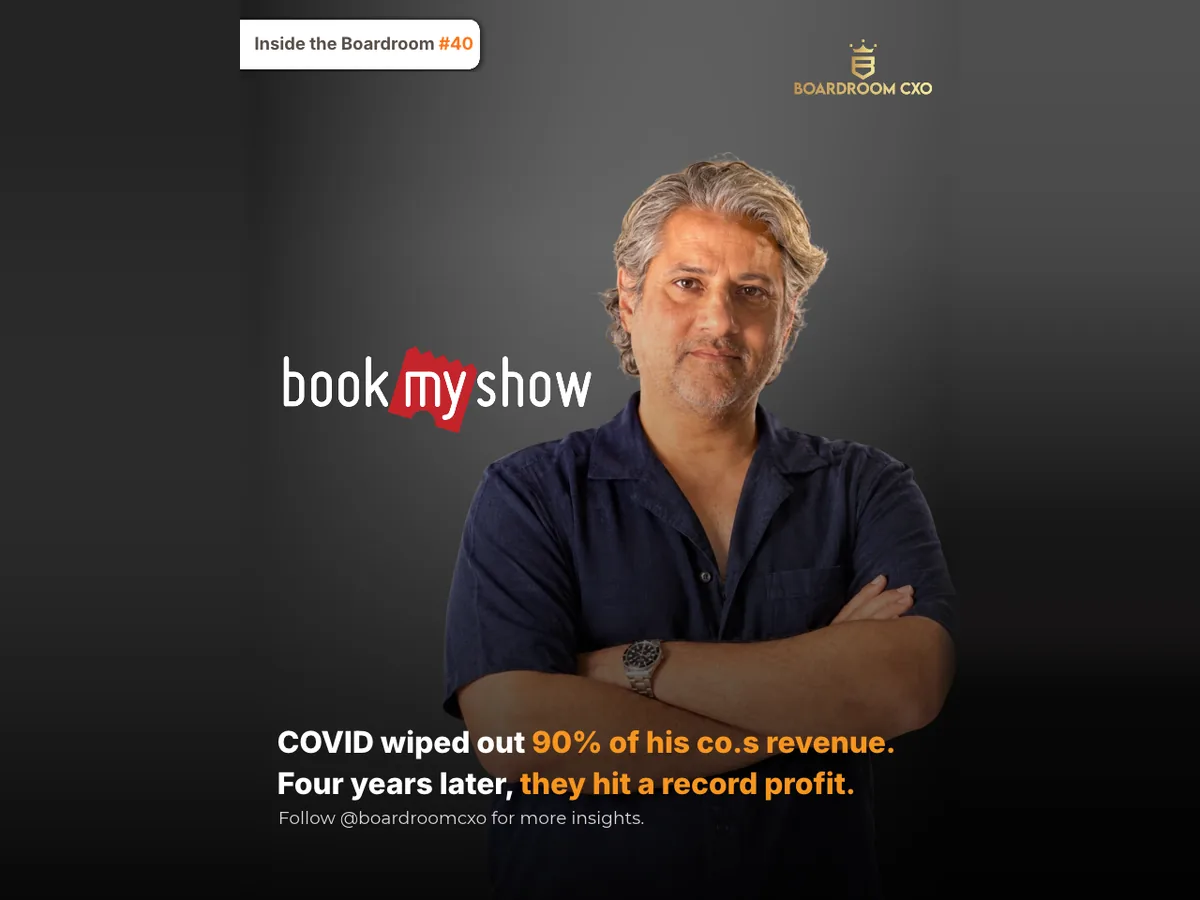
In FY20, BookMyShow's parent company reported consolidated revenue of ₹701 crore. In FY21, its revenue from operations was ₹74 crore. Close to nine of every ten rupees had gone in a single year.
Four years later, in FY25, the same company reported a net profit of ₹192 crore. What happened in between is a lesson in how to cut hard without cutting the future.
How COVID Shut Down BookMyShow's Business
BookMyShow sells tickets to things people do together: films, concerts, plays, comedy shows and sports. When people cannot gather, it has nothing to sell.
On 13 March 2020, the Maharashtra government ordered cinema halls, gyms and swimming pools in Mumbai, Pune, Nagpur and other cities to close from midnight. Within days, cinemas across India were shut, and the national lockdown followed at the end of the month.
The company was not walking into the crisis from a position of comfort. In FY20, the year before COVID, Bigtree Entertainment, which owns BookMyShow, had posted a net loss of about ₹212 crore, up from ₹115 crore a year earlier.
Then revenue fell off a cliff. In FY21, BookMyShow made ₹74 crore from operations and a loss before tax of about ₹220 crore. For a business built on full halls and packed arenas, there was no quick way back. Cinemas and venues were, in Hemrajani's words, the first to shut and the last to open.
Who Is Ashish Hemrajani?
Ashish Hemrajani is the founder and CEO of Bigtree Entertainment Private Limited, the company that owns and operates BookMyShow. He started the business in 1999.
COVID was not his first near-death experience. When the dot-com bubble burst in 2001, the young company survived by selling the Vista ticketing software and running back-end ticketing services for cinema theatres. He launched the BookMyShow brand in 2007, riding the growth of multiplexes and digital payments, and built it into India's largest online entertainment ticketing platform.
In July 2020, a few months into the shutdown, he said the company was going back to that earlier crisis for guidance:
"We are now looking at the lessons we have learnt in 2001 and 2002, and we have revisited all the lessons that we have learnt at that time."
Cut Hard, Keep Building: What Hemrajani Decided
In a crisis, most companies freeze. They cut everything, go quiet and wait for the market to come back. Hemrajani did two things at once. He cut costs deeply, and he kept spending on new lines of business.
The cuts. In May 2020, BookMyShow laid off or furloughed about 270 employees, around 18 per cent of its staff. Hemrajani said the decision came only after the company had cut other expenses and renegotiated with vendors, partners and landlords. The founders and leadership team took a 50 per cent salary cut.
How the company let people go was as telling as the cut itself. Those who left got severance equal to two months' salary. Medical insurance for them and their families was extended till 30 September 2020, along with gratuity and other benefits. Later, the company set up a four-person HR cell to help former employees find new jobs. There were more rounds of pay cuts and resizing as the shutdown dragged into 2021.
He was also clear that profit was not the goal for that year:
"This is not a time for profit... everybody is hurt and we want to give back."
The focus. He shut what did not matter. "We shutdown our consumer business in Indonesia, Malaysia, and Dubai," he said later. "It was a distraction." The team narrowed its plans to four ideas it could execute quickly and where it had a right to win.
The building. BookMyShow went digital on the fifth day of the national lockdown. It hosted live virtual concerts and shows, with artists performing from their homes, and drew 15,000 to 20,000 people watching at the same time. Sponsors and partners paid for many of them.
Then came streaming. Instead of buying a platform, the company built its own pay-per-view movie service, launched in February 2021. Hemrajani explained the maths:
"Investment bankers were quoting Rs 30-40 crore as the budget for acquiring a platform. We built it in-house for Rs 8 crore."
All of this was possible because the company had money in the bank. BookMyShow's habit was to raise capital when it did not need it. "We are sitting on a tonne of cash," he said in July 2020. A business with cash can experiment. A business without it can only think about survival.
What Building Through the Shutdown Delivered
The recovery started as soon as the doors opened. In FY22, revenue from operations rose to about ₹277 crore and the loss before tax shrank to about ₹92 crore.
By November 2022, Hemrajani said the company had been profitable after tax for three straight quarters, with revenue up 2.5 times.
The bigger change was in what the company sold. India came back wanting more than films. In FY25, Bigtree Entertainment reported:
- Total income of ₹1,869 crore, up from ₹1,430 crore in FY24 and more than two and a half times the ₹701 crore of FY20.
- Net profit of ₹192 crore, up from ₹109 crore the year before.
- Live events revenue of ₹756 crore, up from ₹455 crore, now close to the ₹828 crore from ticketing.
The live events business that had been shut for the better part of two years is now one of the company's two main engines.
Demand even outran the company's systems. When Coldplay tickets for India went on sale in September 2024, the site went down for about nine and a half minutes. Hemrajani did not dodge it. "We were underprepared for 10 million instances that hit our site and they were largely bots," he said in January 2025. The company cut the ticket limit per transaction from eight to four.
The Boardroom Lesson: Cut Costs, Not Capability
Every board facing a sudden drop in revenue has to cut. The real question is what it cuts. Hemrajani cut people, pay, overseas markets and his own salary. He did not cut the team's ability to build new products, and he did not spend the company's cash on waiting.
A crisis budget has two columns: what you stop, and what you start. Most companies only fill in the first one.
The online events, the in-house streaming service and the focus on four ideas did not save FY21. They prepared BookMyShow for the day the doors opened. When they did, it had more to sell than before.
Common Mistakes Boards Make When a Crisis Stops Revenue
When the money stops coming in overnight, boards tend to make the same three errors.
They freeze all new spending. A blanket freeze feels safe, but it means the company comes out of the crisis with the same product it went in with. BookMyShow kept a small, cheap pipeline of new ideas alive, including a streaming service built for a fraction of the cost of buying one.
They treat layoffs as only a cost line. The way people leave is remembered by those who stay, by those who leave and by those you will want to hire later. Two months' salary, family medical cover and help finding new jobs cost money. They also protect the employer brand that a recovering company will need.
They keep every market alive out of pride. Overseas consumer businesses in Indonesia, Malaysia and Dubai were part of the growth story. In a crisis, Hemrajani called them a distraction and shut them. Boards should ask which markets earn their place when cash is tight.
A Framework for Hiring a CEO Who Can Lead Through a Shutdown
When we brief boards on a leadership search for a business exposed to sudden shutdowns, we push for three specific checks.
- Ask what they did in the last downturn. Hemrajani had lived through the dot-com bust and went back to those lessons in 2020. A leader who has managed a hard stop before will not be learning on the job.
- Test their build-or-buy judgement. Building a platform for ₹8 crore instead of buying one for ₹30 to 40 crore is a decision about cost, speed and control. Ask candidates for a real example and the numbers behind it.
- Check how they think about cash. Raising money before you need it is what gave BookMyShow room to experiment. Ask how a candidate would fund the business if revenue stopped for a year.
Why This Belongs in the Boardroom, Not Just the Business Pages
BookMyShow's story sits next to the one we told about Ajay Bijli at PVR INOX, whose sales fell 92% in a year when the same cinemas went dark. Both leaders treated the shutdown as a time to prepare, not just to wait.
A closed door is not the test. What you build behind it is.
Sources
- The Quint, Coronavirus: Maha Govt Orders Closure of Theatres, Gyms, Malls, March 2020
- exchange4media, BookMyShow's parent company reports consolidated rev of Rs 701.4 cr in FY20, February 2021
- Business Today, Coronavirus crisis: BookMyShow lays off 270 employees, May 2020
- YourStory, Moviegoers may come back to cinema halls sooner than expected: BookMyShow Co-founder, July 2020
- YourStory, Ashish Hemrajani reveals BookMyShow's playbook on staying the course to steer out of the storm, October 2021
- YourStory, How BookMyShow reinvented its business to create new growth avenues, November 2022
- Business Today, 'We were underprepared for...': BookMyShow CEO on Coldplay ticketing row, January 2025
- Angel One, BookMyShow Parent Reports ₹192 Crore Profit as Live Events Scale Up, January 2026
Related Reading
Ajay Bijli's Sales Fell 92% in a Year. Now 150 Million People Buy His Tickets.
Read → R · 02 Founder Leadership · October 2026Albinder Dhindsa: Zomato Bought His Struggling Startup. Now He Runs Zomato's Parent.
Read → R · 03 Founder Leadership · October 2026Vikram Mehra Took Saregama From ₹19 Crore to ₹206 Crore With Songs From the 1950s
Read →Does your next CEO know what to stop, and what to keep building, when revenue disappears?
We screen for leaders who have run a business through a hard stop before and can show what they cut, what they protected and why. Brief us on your next CXO mandate and we will tell you what the market actually has to offer.
Brief Us on a Mandate See all Sales & Retail roles we fill →