
Key Takeaways
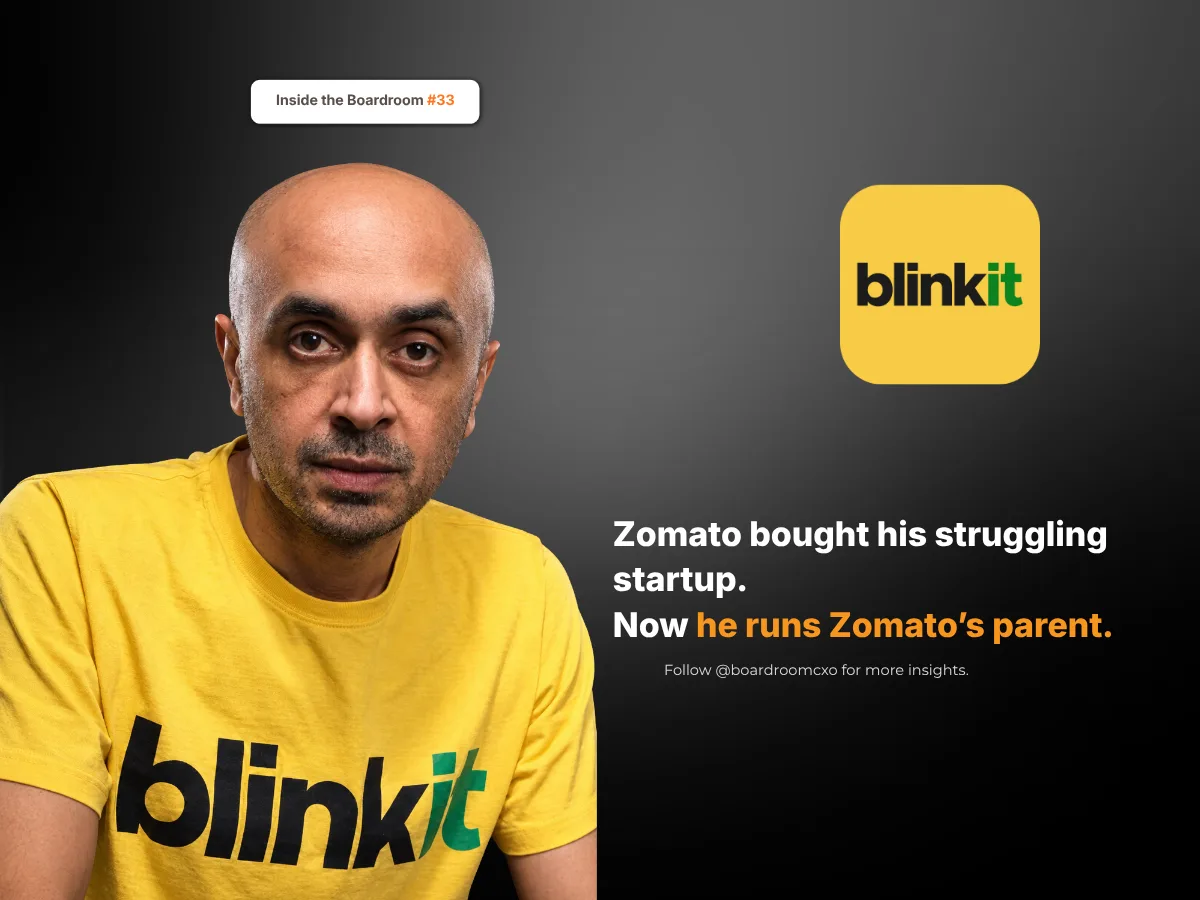
- Grofers renamed itself Blinkit in December 2021 to bet on 10-minute grocery delivery. By March 2022 it had laid off staff in several cities and Zomato had approved a loan of up to $150 million. In June 2022 Zomato agreed to buy it in an all-stock deal.
- In July to September 2022, Blinkit lost ₹259 crore at the adjusted EBITDA level on orders worth ₹1,482 crore, and Zomato told shareholders that most investors gave it zero value. Co-founder Albinder Dhindsa stayed to run it: "Growth is the biggest lever driving improvement in profitability."
- Blinkit's net order value overtook Zomato's food delivery in April to June 2025. A year later, with 2,443 dark stores, it made ₹102 crore of adjusted EBITDA in a quarter, and Dhindsa became CEO of Eternal. Boards should think hard before letting the founder of an acquired business walk away.
"I know that most investors currently ascribe zero value to the Blinkit business, and that's understandable."
Deepinder Goyal, then CEO of Zomato, wrote that in the company's shareholder letter in November 2022.
Zero.
How Blinkit Got There
To see why, go back a year. In December 2021, Grofers renamed itself Blinkit and bet the business on one promise: groceries in about 10 minutes.
The bet burned cash fast. By March 2022, Blinkit had let go of staff across several cities, closed some dark stores and delayed some vendor payments. Zomato approved a loan of up to $150 million to keep it going.
In June 2022, Zomato agreed to buy Blinkit in an all-stock deal. The losses continued. In the July to September 2022 quarter, Blinkit lost ₹259 crore at the adjusted EBITDA level, on orders worth about ₹1,482 crore.
Who Is Albinder Dhindsa?
Albinder Dhindsa is the co-founder of Blinkit and, since February 2026, chief executive of Eternal, the listed company that owns Zomato and Blinkit.
An IIT Delhi graduate with an MBA from Columbia, he spent three years at Zomato, latterly as head of international operations, before leaving in 2014 to build Grofers.
He Stayed
When Zomato bought Blinkit, he stayed on to run it.
Most founders would have taken the exit and moved on. A sale at a low valuation, after layoffs and a rescue loan, is the natural moment to leave.
He did not. He stayed with the 10-minute idea and focused on making it pay. In the same November 2022 letter, he set out how:
"Growth is the biggest lever driving improvement in profitability. Higher throughput leads to growth in revenue per order as well as lower cost, given the high operating leverage in this business."
So he scaled. More dark stores, closer to homes, in more cities. More categories beyond groceries.
What Staying Delivered
The turn came in numbers. In the April to June 2025 quarter, Blinkit's net order value, ₹9,203 crore, overtook Zomato's own food delivery business for the first time.
A year later, in April to June 2026, Blinkit ran 2,443 dark stores. The business that had lost ₹259 crore in a quarter made ₹102 crore of adjusted EBITDA in one.
One more twist. In 2014, Dhindsa left a job at Zomato to build Grofers. On 1 February 2026, he became CEO of Eternal, the company that now owns Zomato, when Deepinder Goyal stepped back from the role.
The Boardroom Lesson: The Market Cannot Price Who Stays
When a business is sold cheaply, its valuation tells you what investors think of its past. It says little about the person running it, and whether they will stay long enough to change the answer.
The market can price a business at zero. It cannot price the person who refuses to leave it.
Zomato's decision to keep the founder in charge, and Dhindsa's decision to stay, turned a written-off acquisition into the largest part of the group.
Common Mistakes Boards Make After Acquiring a Founder-Led Business
Boards that buy a struggling founder-led company tend to make the same three errors.
They let the founder leave with the cheque. The founder often understands the model's economics better than anyone. Losing them at the low point can mean losing the turnaround.
They replace the bet with the parent's playbook. Zomato did not turn Blinkit into a slower, safer grocery business. It let the 10-minute model scale.
They judge the deal on the first year's losses. Blinkit's numbers in 2022 looked like a mistake. The fair test was what the business did once it reached scale.
A Framework for Keeping Founders After an Acquisition
When we brief boards on a leadership search linked to an acquisition, we push for three specific checks.
- Ask whether the founder still believes in the model. A founder who stays out of conviction is worth more than one held by an earn-out.
- Agree what success looks like, in numbers. Dhindsa's case rested on throughput and operating leverage. Boards should know which metrics will show whether the bet is working.
- Plan for the founder's next role. The person who turns around an acquired business may be the group's next leader. Build that into succession planning early.
Why This Belongs in the Boardroom, Not Just the Business Pages
This sits alongside the story we told of Saugata Gupta at Marico, who bought founder-led brands and kept the parent company out of their way. Zomato did the same with Blinkit, and the founder ended up running the whole group.
A valuation is a verdict on the past. The person who stays writes the next one.
Sources
- Business Today, Grofers rebrands to Blinkit in line with its 10-min grocery delivery plan, December 2021
- Inc42, Zomato to give $150 Mn loan to Blinkit, March 2022
- Zomato Limited (BSE filing), Shareholders' letter, Q2 FY23, November 2022
- MediaNama, Zomato Q1 FY26 earnings: Blinkit's net order value grows 127%, July 2025
- YourStory, Deepinder Goyal steps down as Eternal's Group CEO, January 2026
- YourStory, Coming full circle: Tracing the journey of Eternal's new CEO Albinder Dhindsa, January 2026
- Inc42, Blinkit's Q1 adjusted EBITDA rises to ₹102 Cr, July 2026
Related Reading
Saugata Gupta Bought Founders, Not D2C Teams. Then He Kept Marico Out.
Read → R · 02 Founder Leadership · November 2026Varun Alagh: When Honasa Fell 40%, He Bought More
Read → R · 03 Founder Leadership · November 2026Ajay Bijli's Sales Fell 92% in a Year. Now 150 Million People Buy His Tickets.
Read →Acquiring a founder-led business and deciding who should run it next?
We screen for leaders who stay with a hard bet after the deal closes, not just those who can manage what is already working. Brief us on your next CXO mandate and we will tell you what the market actually has to offer.
Brief Us on a Mandate See all Sales & Retail roles we fill →