
Key Takeaways
- In FY14 Saregama's music revenue fell 18.5% to about ₹114 crore. It had licensed its physical music business to Sony DADC in July 2013 and had not bought new film music since the 1990s. Its MD resigned in February 2014.
- Vikram Mehra joined from Tata Sky in October 2014. A 2015 study showed that for listeners over 40, getting to the old songs they loved was a huge hassle. Saregama built Carvaan, a player with 5,000 classic Hindi songs, and it sold a million units in about 16 months.
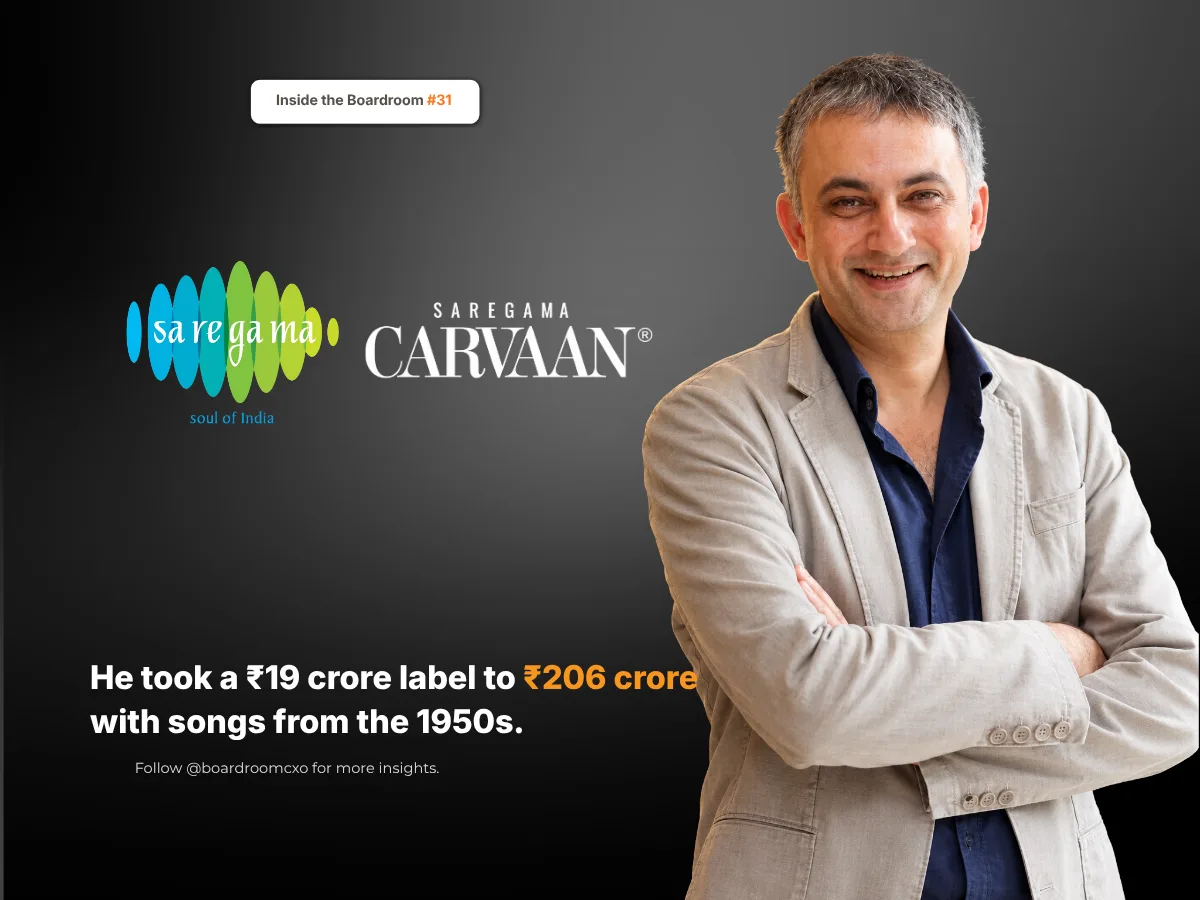
- In FY26 Saregama's music business brought in ₹684 crore, about six times its FY14 level, and consolidated profit was ₹206 crore against ₹19 crore in FY14. Boards should value what a company already owns before buying something new.
In FY14, Saregama's music revenue fell 18.5%, to about ₹114 crore.
The label, once India's best-known name in film music as HMV, had licensed its physical music business to Sony DADC in July 2013 to focus on digital. It had not bought new film music since the 1990s. In February 2014, its managing director resigned.
On paper, Saregama looked like a company living off its past.
Who Is Vikram Mehra?
In October 2014, Vikram Mehra joined as managing director. He came from Tata Sky, where he had been chief marketing officer and chief commercial officer, and before that from STAR TV. An IIT Roorkee engineer with an MBA from IIM Lucknow, he had spent his career on marketing, customers and what they actually want.
What he inherited was a catalogue of more than a lakh songs, many of them classics from the 1950s to the 1980s.
He Started With the Listener, Not the Catalogue
Most leaders in that seat would have chased new film music to look current again. He went back to the people who loved the old songs.
"In 2015, we conducted a big study about music consumption behaviour in India," he told Outlook Business.
The study, across 23 cities, found something simple: for anybody above 40, getting to the music they loved was a huge hassle. The songs were on phones and apps that this audience did not use easily.
Selling the songs more cheaply was not the answer. Saregama tried that: by 2016 it was offering songs on its website for as little as ₹2 each.
Carvaan: The Old Songs in a New Box
So Saregama built a product instead. Carvaan, launched in 2017, was a retro-styled music player that came preloaded with 5,000 classic Hindi songs from the 1950s to the 1980s. No app, no download, no internet. Switch it on and the songs play.
It was not cheap. By late 2017 it sold for ₹5,990. It still sold a million units in about 16 months.
The same catalogue was then licensed to the streaming platforms and to video, earning money every time a song was played.
What the Old Songs Earned
In FY26, Saregama's music business brought in ₹684 crore, about six times its FY14 level. The company's consolidated profit was ₹206 crore, against ₹19 crore in FY14.
Saregama now buys new music again. But the turnaround was built on songs it already owned.
The Boardroom Lesson: An Old Catalogue Is Not a Dead Asset
When a business is shrinking, boards tend to look outward: new markets, new products, an acquisition. The asset already on the balance sheet, written down and ignored, rarely gets a second look.
An old catalogue is not a dead asset. It is the one thing no competitor can copy.
Mehra's answer was to find the customers who still wanted the old songs, learn why they were not buying them, and build what they needed.
Common Mistakes Boards Make With a Legacy Asset
Boards of companies with a large back catalogue, an old brand or a heritage product tend to make the same three errors.
They treat old as worthless. A catalogue that earns little today may be underused, not unwanted. Ask who still values it and what is stopping them from paying.
They compete on price. Selling songs for ₹2 did not change the business. A product built for the customer did, at a premium price.
They chase the newest thing to look current. New film music was where every rival competed. Saregama's edge was the music nobody else owned.
A Framework for Hiring a Leader to Revive a Legacy Business
When we brief boards on a CXO search for a company with a valuable but underused legacy, we push for three specific checks.
- Look for leaders who start with customer research. Mehra's turn began with a study, not a strategy deck. Ask candidates how they found out what customers actually needed.
- Value marketing and consumer backgrounds for asset-heavy businesses. Saregama's MD came from a pay-TV company, not a music label. Understanding the customer mattered more than knowing the industry.
- Ask what the candidate would do with what the company already owns. The right leader will find value in the existing assets before asking for money to buy new ones.
Why This Belongs in the Boardroom, Not Just the Business Pages
This sits alongside the story we told of Rajiv Bajaj and the Chetak, another old name that came back on a new product. And it echoes Siddhartha Lal at Royal Enfield, who built growth on a brand others had written off.
The past is not always a burden. In the right hands, it is the asset nobody else has.
Sources
- MediaNama, Saregama will focus on digital music after licensing physical rights to Sony DADC, July 2013
- MediaNama, Saregama CEO Surya Mantha resigns, February 2014
- MediaNama, Saregama Q4 FY14 earnings, June 2014
- MediaNama, Saregama appoints Tata Sky CCO Vikram Mehra as MD, August 2014
- Techlomedia, Download songs legally from Saregama at just Rs 2 per song, July 2016
- Business Standard (PTI), Carvaan hits one million units sales in 16 months, December 2018
- Outlook Business, Carvaan: A journey begins, March 2019
- Indian Television, Saregama FY26 profit rises as music and artist business strike a chord, May 2026
Related Reading
Rajiv Bajaj Walked Away From Scooters. Then He Rebuilt the Chetak Name.
Read → R · 02 Founder Leadership · August 2026Everyone Said Royal Enfield Was Finished. Siddhartha Lal Asked for Two Years.
Read → R · 03 Founder Leadership · November 2026Shailesh Chandra Took Over Tata's Cars at Their Low Point. Sales Are Now Nearly 5x.
Read →Sitting on an old brand or catalogue that the market has written off?
We screen for leaders who see value in what a company already owns, not just in what it could buy next. Brief us on your next CXO mandate and we will tell you what the market actually has to offer.
Brief Us on a Mandate See all Marketing & CMO roles we fill →