
Key Takeaways
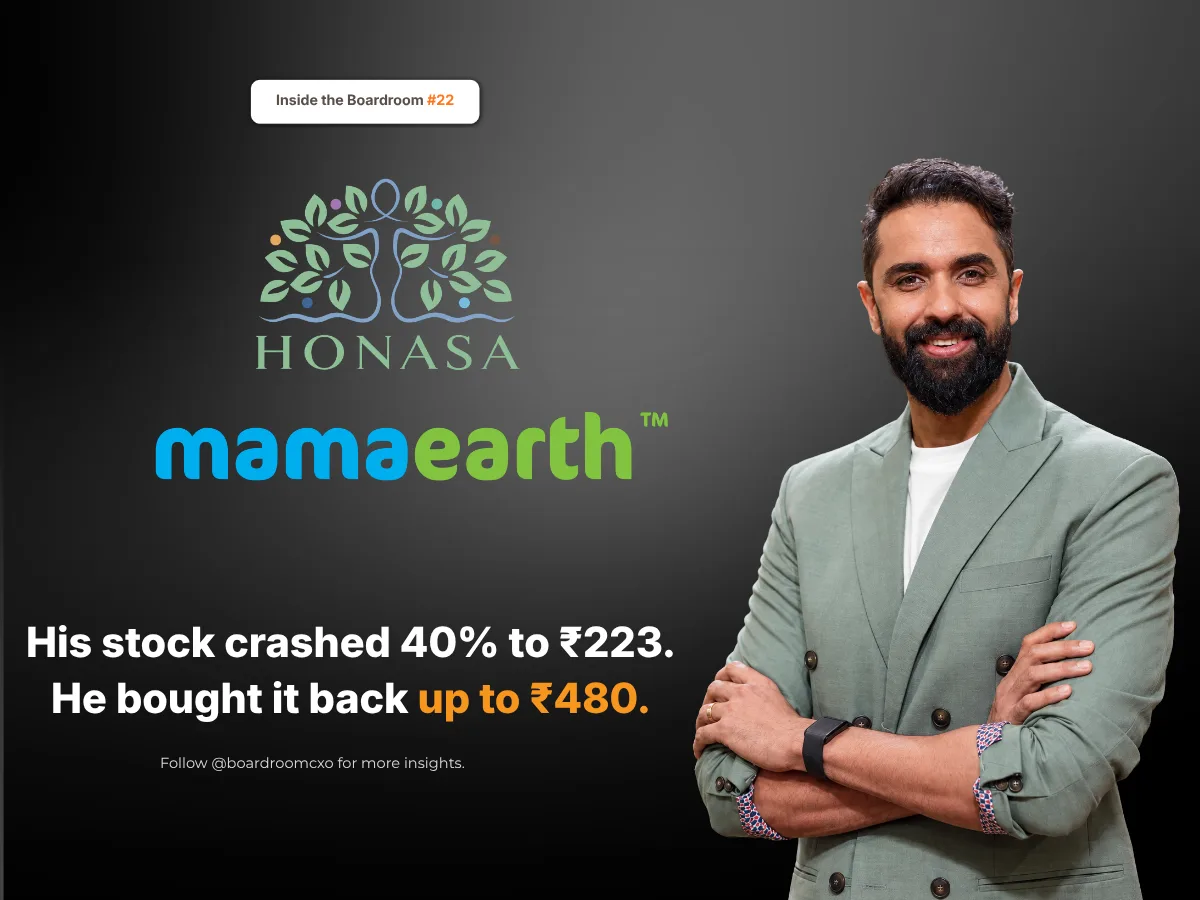
- Honasa Consumer, Mamaearth's parent, posted its first quarterly loss as a listed company in November 2024 and its stock fell about 40% to around ₹223.
- Co-founder and CEO Varun Alagh bought shares twice: about ₹4.5 crore in December 2024 and ₹50 crore in December 2025, taking the promoter group above 35%.
- Quarterly profit reached ₹39 crore and then ₹50 crore, and by September 2026 the stock was near ₹480. Boards should ask whether a founder's conviction comes with a fix, not just a signal.
It started with a question, not a business plan. In 2016, Ghazal Alagh's infant son developed a skin reaction, and when the family went looking for a genuinely toxin-free baby product in India, they could not find one. So they built one.
Mamaearth launched with six baby-care products, and the question behind all of them was simple: is this safe for my child?
Eight years later, that question had grown into Honasa Consumer, which calls itself India's largest digital-first beauty and personal care company. Then, in November 2024, the market decided the story was over.
Who Is Varun Alagh?
Varun Alagh is the co-founder and chief executive of Honasa Consumer, the house of brands behind Mamaearth. He founded the company with his wife, Ghazal Alagh, in 2016, and took it public in November 2023 at ₹324 a share.
What Happened in November 2024
For the quarter to September 2024, Honasa reported a net loss of about ₹19 crore, against a profit of ₹29 crore a year earlier. It was the company's first quarterly loss since listing. Revenue fell about 7%.
The cause had a name. Project Neev, a change to how Honasa sold through distributors in India's 50 largest cities, removed a layer from its distribution network and forced a ₹63 crore correction of the inventory sitting with stockists.
The stock hit its 20% lower circuit on 18 November, below its own IPO price, and kept falling. About ₹3,500 crore of market value was erased in two trading sessions. By the end of that week the shares had fallen as much as 40%, to a low of about ₹223. Commentators started writing the obituary early: another overhyped D2C listing, unravelling on schedule.
What He Did Instead of Arguing
Varun Alagh did not put out a statement disputing that story. He bought the stock instead. A filing in early December 2024 showed he had spent about ₹4.5 crore of his own money on Honasa shares, taking his stake to 31.93%. The stock hit its upper circuit the day the news came out.
That would have been the easy place to stop. He did not. The quarters began to turn: for the three months to September 2025, Honasa reported a profit of ₹39 crore against a loss a year before. Then, on 29 December 2025, with the company still proving itself one quarter at a time, he bought again. About 18.5 lakh shares this time, at ₹270 each, roughly ₹50 crore, from early investor Fireside Ventures. That took his own stake to 32.45% and the promoter group's holding above 35%.
The next quarter, profit reached ₹50 crore, up 93% on the year before, on revenue up 16% to about ₹602 crore. Mamaearth itself was growing again.
"Our flagship brand is back to double digit growth, driven by product superiority," Mr. Alagh said.
The stock that once traded at ₹223 was near ₹480 by September 2026.
The Boardroom Lesson: Markets Test Conviction With Numbers
Most coverage of a crashing stock asks what management will say. Alagh's answer was not a statement. It was a filing showing more of his own money in the company, and then a second, much larger one a year later.
A market tests conviction with numbers. Founders answer it with their own money.
Buying shares is a signal, not a fix. What made it credible was that the fix was already under way: the distribution change that caused the loss was the same change the company kept working through, and the profit that followed came from the business, not from the share price.
Common Mistakes Boards Make When a Founder-Led Company Hits Its First Bad Quarter
Boards of listed D2C and consumer companies, and the investors watching them, tend to make the same three errors.
They read one bad quarter as the end of the story. Honasa's loss came from a deliberate distribution change with a known, one-time inventory cost. That is a different problem from demand disappearing, and it deserves a different response.
They mistake a founder's share purchase for a plan. Insider buying tells you what the founder believes. It does not tell you whether the operating fix will work. Boards should ask for both, and judge them separately.
They rush to replace leadership before the fix has had time to work. Honasa's recovery took four quarters to show. A board that changed the CEO in the first one would have reset the clock on a change that was already paying back.
A Framework for Evaluating a Founder-CEO After a Stock Crash
When we brief boards on a CXO search for a founder-led consumer or D2C brand going through a rough stretch, we push for three specific checks.
- Separate the cause from the reaction. Ask what actually caused the bad quarter. A one-time cost from a deliberate change, like Project Neev's inventory correction, calls for patience. A loss of customers calls for a different conversation.
- Look at what the founder does with their own money. Alagh bought twice, a year apart, the second time more than ten times larger. Repeated buying while results are still uncertain says more than a single purchase timed to a press cycle.
- Hire the leaders who make the fix stick. A founder's conviction does not run a distribution network. The quarters turned because sales, supply chain and brand teams executed the change. Ask whether the team around the founder can carry it.
Why This Belongs in the Boardroom, Not Just the Business Pages
This sits alongside the story we told of Sudhir Sitapati at Godrej Consumer: a consumer business where the leader's choices only made sense once enough quarters had passed to judge them. Honasa's version played out in public, on a stock price that fell faster than the business did.
The market will always test a founder with numbers. The founders worth backing answer with a plan, and with their own money behind it.
Sources
- Business Standard, Mamaearth parent loses $415 mn in value as Q2 loss fans demand worries, November 2024
- Business Standard, Honasa Consumer stock tanks 20%, hits 52-week low on weak Q2 results, November 2024
- YourStory, Explained: How distribution woes, inventory correction hit Mamaearth stocks, November 2024
- Angel One, Honasa Consumer Share Price Hits Upper Circuit; Founder Raises Stake in the Firm, December 2024
- Inc42, Honasa CEO Varun Alagh Buys Shares Worth INR 50 Cr From Fireside Ventures, December 2025
- Entrackr, Varun Alagh increases his stake in Honasa to 32.45% via Rs 50 Cr block deal, December 2025
- Inc42, Honasa Q3: Profit Zooms 93% YoY To ₹50 Cr, February 2026
- YourStory, How finding the right solution for their baby led these parents on their entrepreneurial journey: the story of Mamaearth, March 2021
Related Reading
Sudhir Sitapati: Why He Left HUL's Safest Seat for Godrej
Read → R · 02 Founder Leadership · November 2026Gaurav Singh Kushwaha: BlueStone's First Profit Came Without a Turnaround
Read → R · 03 Founder Leadership · July 2026Refused to Blink: The Boardroom Lesson Behind Marico's War With Hindustan Lever
Read →Running a D2C or beauty brand through a hard stretch and need leaders who will stay the course?
We screen for candidates who have fixed distribution, inventory and growth problems from the inside, not just grown a brand in good years. Brief us on your next CXO mandate and we will tell you what the market actually has to offer.
Brief Us on a Mandate See all Marketing & CMO roles we fill →