
Key Takeaways
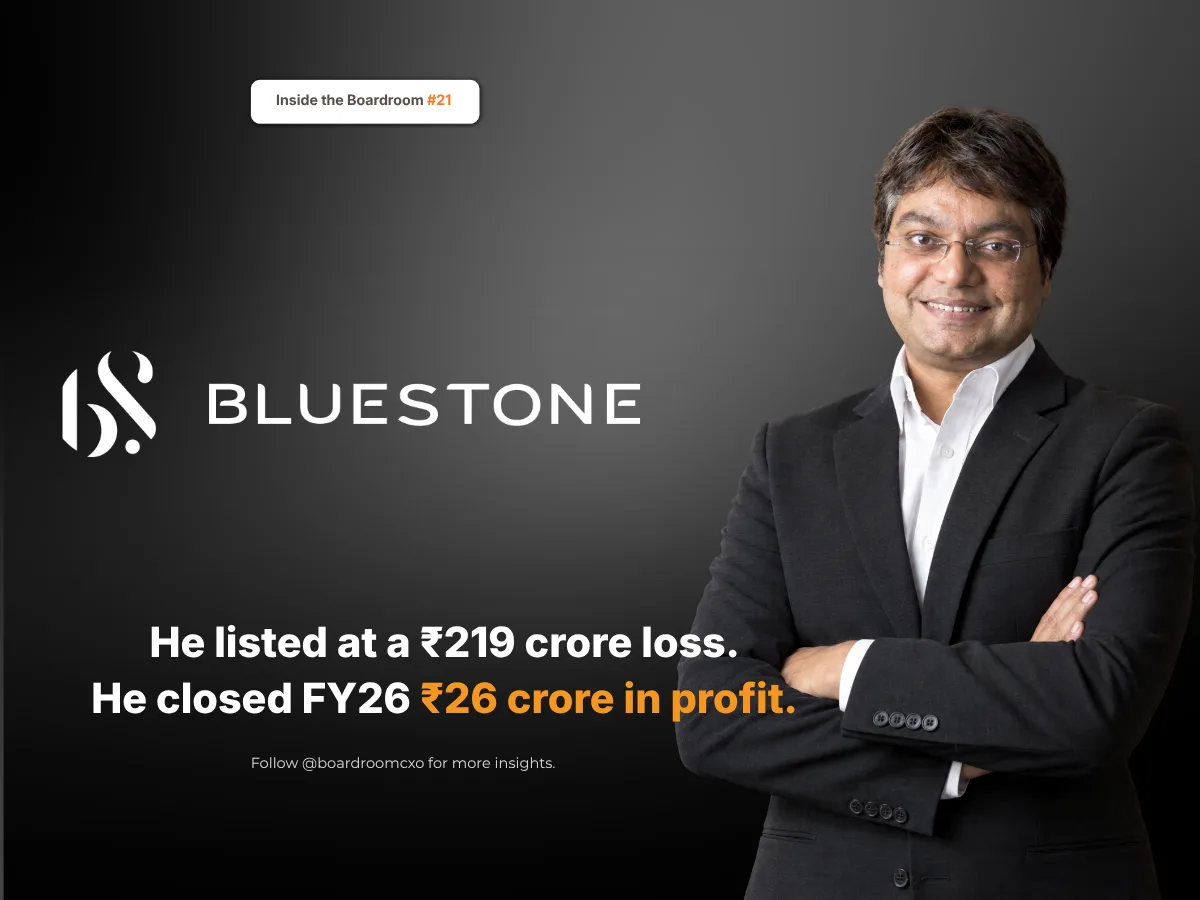
- BlueStone listed on 19 August 2025 at ₹510 a share, below its ₹517 issue price, after losing ₹219 crore in FY25.
- In FY26 revenue grew 38% to ₹2,441 crore and the company reported its first full-year profit, ₹26 crore, without a rescue plan or a pivot.
- The profit came from stores maturing and marketing falling to 6.6% of sales, helped by a one-off gain on gold inventory, so boards should check which numbers carry the result.
On 19 August 2025, one of India's most closely tracked consumer IPOs of the year listed on the NSE at ₹510 a share, seven rupees below its own ₹517 issue price.
The conventional read was immediate. Overpriced. Loss-making. Wrong year to test public markets. BlueStone had lost ₹219 crore in FY25, the year before it went public, on revenue of ₹1,770 crore.
Here is what that read missed. A discount debut is the market's verdict on a single day. It is not a verdict on the arithmetic underneath a business, and that arithmetic takes years, not quarters, to show up.
Who Is Gaurav Singh Kushwaha?
Gaurav Singh Kushwaha is the founder, managing director and chief executive of BlueStone Jewellery and Lifestyle. He launched BlueStone in 2011 as a digital-first, direct-to-consumer jewellery brand, then spent the following years building it into an omnichannel retailer with its own stores and its own manufacturing. By March 2026 it ran 340 stores across 134 cities.
What He Did After the Weak Listing
Very little that made news. In the earnings calls after the listing there was no rescue plan and no pivot. The claim was the same each time: nothing in the model was new, and the company was only now old enough for the numbers to show it.
Then the mechanism got specific. Advertising and promotion fell to 6.6% of sales in FY26, from 9% a year earlier. On the fourth-quarter call, Kushwaha said it had come down from 12% over two to three years while still growing in rupees, because revenue grew faster. Older stores kept getting more productive as they matured. BlueStone opened 65 stores in FY26, and same-store sales in the fourth quarter still grew 34% on the base already in place.
By the time FY26 closed, revenue was up 38% to ₹2,441 crore. Adjusted EBITDA rose from ₹131 crore to ₹493 crore. BlueStone reported its first full year of profit as a listed company, ₹26 crore, against the ₹219 crore loss a year before.
The Part Most Companies Leave Out of the Press Release
Some of that profit was not earned in a showroom. Gold rose sharply through the year, and BlueStone was holding inventory worth more than it had paid for it. Kushwaha called the jump in closing inventory value a one-off on the fourth-quarter call, one that most of the industry saw.
Strip the gold gain out and the business still improved, on a smaller, plainer number. One analyst on the same call worked out that fourth-quarter gross profit excluding the inventory gain grew 36%, against sales growth of nearly 49%. The company's chief financial officer said the margins it quotes for its mature stores include no inventory gain at all.
Kushwaha did not call any of it a turnaround. Not the operating numbers, and not the gold-assisted ones either.
"Nothing changed overnight," he said.
BlueStone also cut net debt to about ₹347 crore over the same year, from about ₹617 crore. It was a number nobody outside the balance sheet was asking about.
The Boardroom Lesson: Profit Does Not Always Arrive With a Headline
Most coverage of a weak listing treats the first day's price as the story. It is one data point. What decided BlueStone's year was a set of slow, unglamorous ratios: marketing as a share of sales, how fast a store reaches maturity, and same-store growth on a base that was already large.
Sometimes profit just arrives on time.
None of those ratios moves in a quarter, and none of them makes a good press release. That is exactly why a leader who keeps explaining the same model, quarter after quarter, is easy to underrate.
Common Mistakes Boards Make When Judging a Consumer CEO After a Weak Listing
Boards of loss-making consumer and D2C brands, and the investors watching them, tend to make the same three errors.
They read the listing price as a verdict on the leader. BlueStone's ₹7 discount said something about sentiment in August 2025. It said nothing about whether the stores opened in earlier years were on track to pay back.
They reward a pivot over a plan. A new strategy announced after a bad debut looks decisive. The less visible choice, holding the model and letting store cohorts mature, is often the one that produces the profit.
They take the headline profit at face value. In a year when gold rose sharply, part of every jeweller's profit came from inventory it already held. A board should know how much of the result is the business and how much is the commodity.
A Framework for Evaluating This Kind of Leader
When we brief boards on a CXO search for a store-led jewellery, retail or D2C brand, we push for three specific checks.
- Ask for the store cohort numbers. A leader who can show how stores opened in a given year perform in their third and fourth years understands where the profit will come from. A leader who only talks about total revenue may not.
- Test how they think about marketing as a share of sales. BlueStone took advertising from 12% of sales to about 6% while spending more in rupees. Ask candidates what their floor is, and what they would spend the extra on once the store network is in place.
- Ask them to separate the business from the commodity. In jewellery, gold moves the reported numbers every year. Leaders worth hiring volunteer the number without the gold gain before anyone asks.
Why This Belongs in the Boardroom, Not Just the Business Pages
This sits alongside the pattern we examined in C K Venkataraman's years at Tanishq: a jewellery business whose real progress showed up only after years of fixing unglamorous fundamentals. BlueStone's version played out in public, one quarter after a listing the market had already marked down.
The market will always react to the first day. Boards that hire well look past it, to the leader who can explain where the profit will come from, and then delivers it on the timeline they gave.
Sources
- BlueStone Jewellery and Lifestyle, Q4 FY26 Press Release: first full year of positive reported PAT, April 2026
- BlueStone Jewellery and Lifestyle, Q4 FY26 Earnings Call Transcript, April 2026
- Business Standard, BlueStone Jewellery IPO makes poor debut; shares list at 1% discount, August 2025
- Storyboard18, Bluestone tightens marketing spend in Q1 FY26, margins jump to 16.8%, 2025
Related Reading
C K Venkataraman: How Tanishq Fixed Years of Being Wrong About India
Read → R · 02 Founder Leadership · September 2026M P Ahammed: How a Coconut Trader Built India's Largest Jeweller
Read → R · 03 Founder Leadership · August 2026Aukera Raised ₹90 Cr: Inside India's Lab-Grown Diamond Race
Read →Building a jewellery or D2C brand and need leaders who know where the profit will come from?
We screen for candidates who understand store maturity, marketing as a share of sales and the gold in the numbers, not generalists borrowing a playbook from another category. Brief us on your next CXO mandate and we will tell you what the market actually has to offer.
Brief Us on a Mandate See all Sales & Retail roles we fill →