
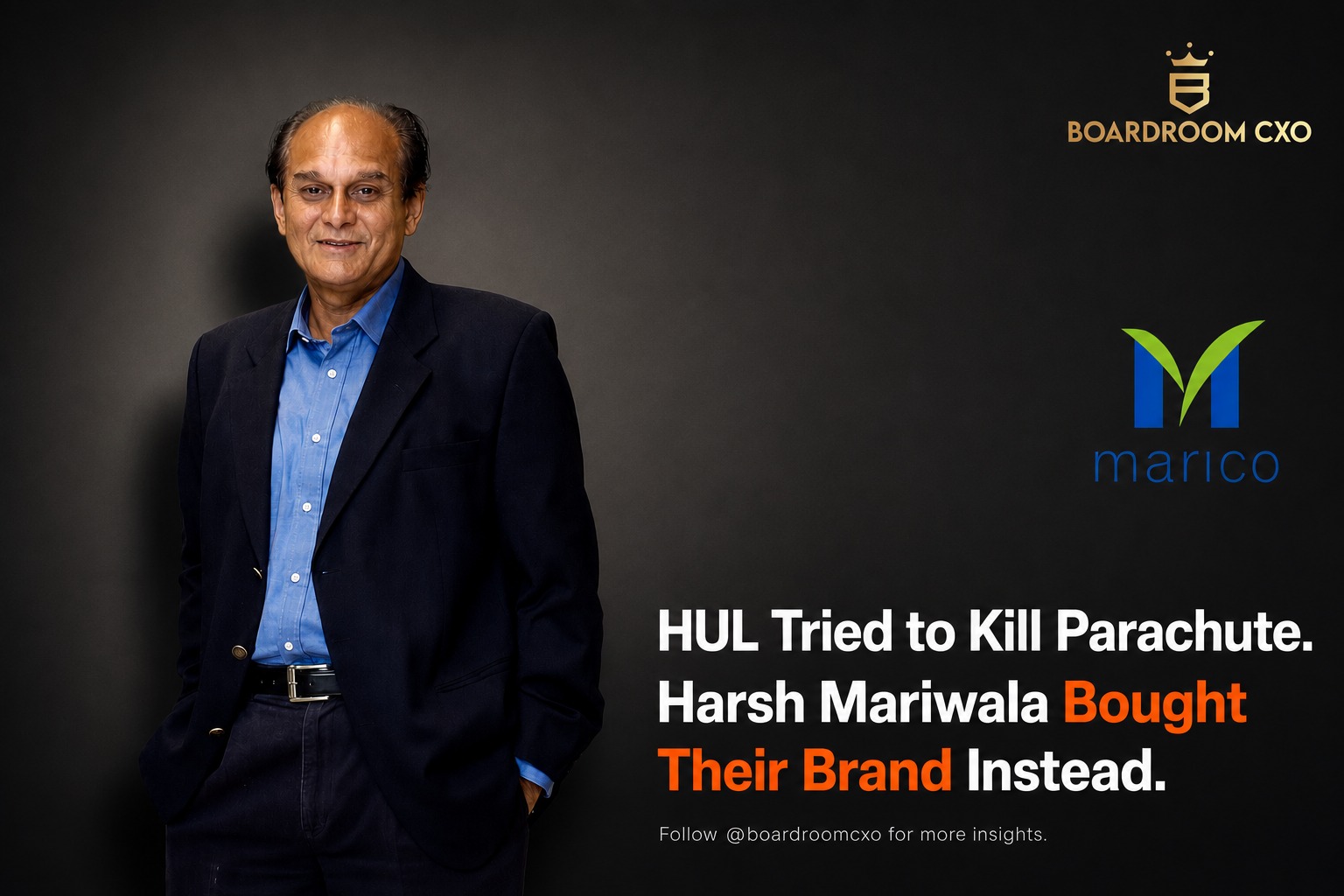
In 1999, Hindustan Lever, now Hindustan Unilever, decided to kill Parachute. Not compete with it. Kill it.
The multinational giant launched its own coconut hair oil, Nihar, and went straight after the one brand that mattered most to a much smaller company called Marico Limited. Parachute was not just any product for Marico. It brought in up to 60% of the company's profits. If Parachute fell, Marico fell with it.
Hindustan Lever knew that.
The Cheque on the Table
They approached Harsh Mariwala more than once, along with bankers, suggesting he simply sell the company and walk away. On paper, it made sense. He was a commerce graduate running a business he had carved out of his family's old commodity trading firm. Now the largest FMCG company in the country wanted his crown jewel. Most founders would have taken the cheque.
He said no.
His reasoning was simple. He knew coconut oil better than anyone, and Marico still held around 50% of the market. So instead of selling, he fought, on four fronts at once.
The Four Fronts
He improved the product. He built emotional advertising around what coconut means in Indian homes, in weddings, in daily rituals. He pushed harder into rural distribution. And he put real power in the hands of his ground sales staff, because he understood that FMCG battles are won street by street, not in boardrooms.
FMCG battles are won street by street, not in boardrooms.
Marico held its ground. Then it won. Years later, in a twist nobody saw coming, Marico bought the Nihar brand from Hindustan Unilever itself.
Today Marico sells across 25 countries and is worth well over ₹80,000 crore. The coconut oil brand a giant tried to bury is still a leader.
Why This Belongs in a Boardroom Conversation
Every founder who has built something worth defending eventually gets the version of this offer, a buyout, an acqui-hire, a "strategic partnership" that quietly ends with someone else owning the thing they built. The decision to stay and fight instead of sell is not a strategy slide. It is a leadership call, made under real pressure, with the company's survival on the line.
What made Marico's answer credible was not conviction alone. It was that the conviction could actually be executed, on four fronts, at the same time, by people who owned each front. Product. Brand. Distribution. Ground sales. A founder cannot run all four personally at scale. That takes a bench.
The market does not remember who had the bigger budget. It remembers who refused to blink, and who had the leadership in place to back that decision up.
Frequently Asked Questions
Why did Hindustan Lever try to kill Parachute in 1999?
Hindustan Lever, now Hindustan Unilever, launched its own coconut hair oil, Nihar, to directly attack Parachute, the Marico brand that generated up to 60% of Marico's profits. Weakening Parachute would have crippled Marico as a company.
Why did Harsh Mariwala refuse to sell Marico to Hindustan Lever?
Hindustan Lever and its bankers approached Harsh Mariwala more than once suggesting he sell the company. He refused because he knew the coconut oil category better than anyone and Marico still held around 50% of the market, so he chose to fight rather than exit.
What were the four fronts Marico fought on against Hindustan Lever?
Marico improved the product itself, built emotional advertising around coconut oil's role in Indian households, pushed harder into rural distribution, and gave real power to its ground sales staff, fighting on product, brand, distribution, and ground sales simultaneously.
What happened to Marico after the war with Hindustan Lever?
Marico held its ground and won. Years later, Marico bought the Nihar brand from Hindustan Unilever itself. Today Marico sells across 25 countries and is worth well over ₹80,000 crore.
What is the boardroom leadership lesson from Marico's fight with Hindustan Lever?
Conviction alone does not win a category war. It has to be executable on every front, product, brand, distribution, and ground sales, at the same time, by leaders who each own their front. A founder cannot run all four personally at scale, which is why the leadership bench matters as much as the decision to fight.
Related Reading
Sanjiv Mehta: The HUL Leader Who Never Forgot Bhopal
Read → R · 02 Founder Leadership · July 2026Suresh Narayanan: The MD Who Walked Into the Maggi Ban
Read → R · 03 Founder Leadership · July 2026Sudhir Sitapati: Why He Left HUL's Safest Seat for Godrej
Read →Building the bench for the fight you're not backing down from?
Whether it's a category leader coming after your core product or an IPO timeline that will not wait, we place the marketing, sales, BD, and ops leaders who can execute the fight, not just plan it.
Brief Us on a Mandate