
Key Takeaways
- Birla Opus launched in February 2024 with ₹10,000 crore of investment, capacity equal to 40 per cent of the Indian paint industry, and prices about 5 to 6 per cent below Asian Paints.
- In FY25, Asian Paints' decorative volume grew just 2.5 per cent and value fell 5.7 per cent, but Amit Syngle did not match the discounts and kept investing in the brand, new categories and cost efficiency.
- Decorative volume grew 10.9 per cent in July to September 2025 and 12.4 per cent in January to March 2026, when consolidated net profit rose 69 per cent to ₹1,172 crore.
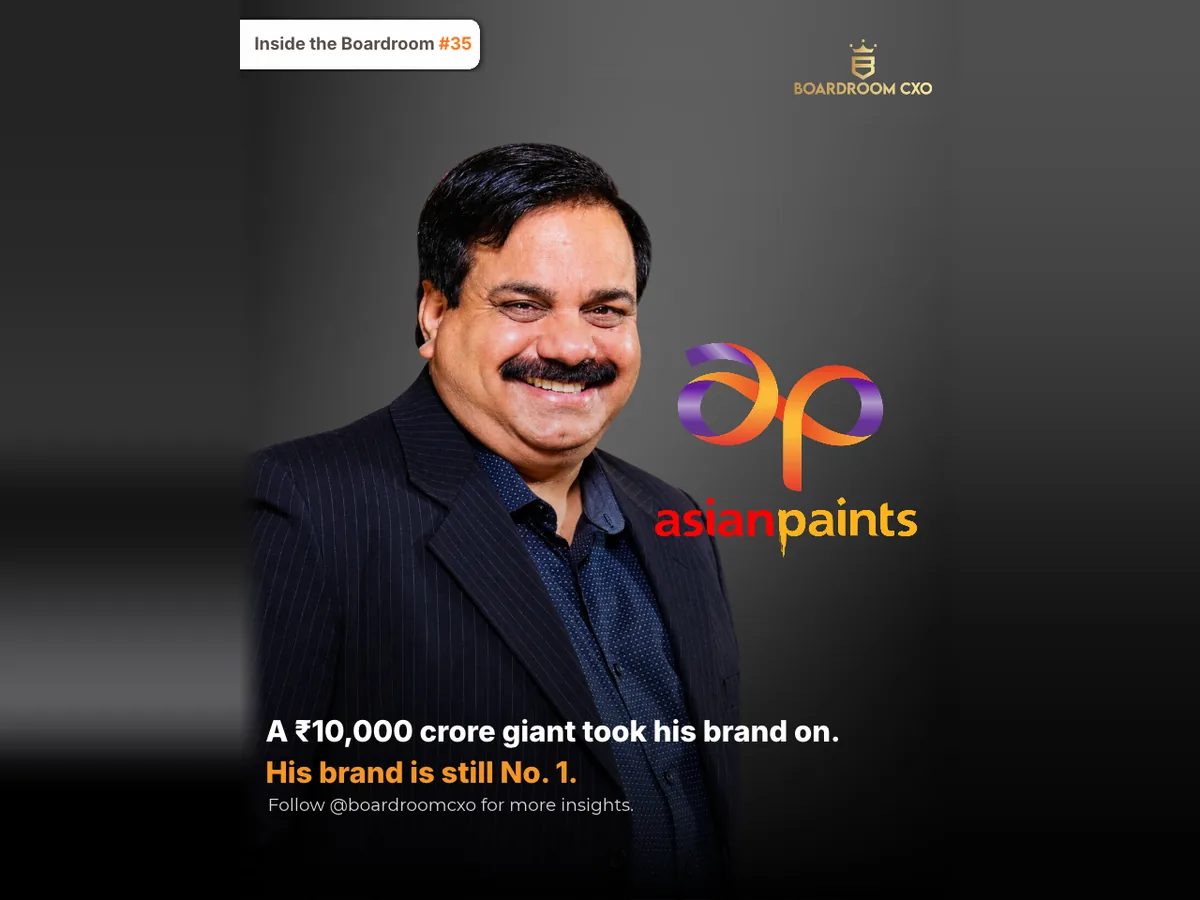
A rival with ₹10,000 crore and lower prices came for India's biggest paint company. Its CEO refused to fight on price.
In February 2024, the Aditya Birla Group launched Birla Opus. It was one of the largest entries any Indian consumer market had seen in years.
Asian Paints had led Indian decorative paints for decades. Within a year, its growth had nearly stopped. What its MD and CEO, Amit Syngle, did next is a useful case for any board facing a well-funded challenger.
How Birla Opus Started a Paint Price War
Birla Opus did not arrive quietly. Grasim, the Aditya Birla company behind it, committed an upfront investment of ₹10,000 crore. It planned six factories with a total capacity of 1,332 million litres a year. The group said that was a 40 per cent addition to the capacity of the entire Indian paint industry.
Chairman Kumar Mangalam Birla set the goal plainly. The group wanted to become a profitable number two in the coming years.
Then came the prices. When Birla Opus released its price list in March 2024, Business Today reported that its products were priced at a 5 to 6 per cent discount to Asian Paints. It added a launch offer of 10 per cent extra paint on water-based products. Dealers were offered better margins and longer credit.
Asian Paints felt it. In FY25, its domestic decorative business grew just 2.5 per cent in volume, while value fell 5.7 per cent. Kotak's analysts called it the weakest showing in two decades. In the January to March 2025 quarter, volume grew only 1.8 per cent and decorative revenue fell 5.2 per cent. Business Standard noted it was the fifth quarter in a row of falling revenue. Most brokerages expected Asian Paints to keep losing share.
Who Is Amit Syngle?
Amit Syngle has been Managing Director and CEO of Asian Paints since April 2020. His current term runs to March 2028.
He has spent more than three decades at the company. He started in sales, headed its North and Central regions, and was Chief Operating Officer of the Indian decorative business before taking the top job. He studied mechanical engineering at Punjab Engineering College and has an MBA from Panjab University.
When Birla Opus arrived, he publicly said there was space for everyone in the market. The harder question was what to do when the numbers turned.
Why Asian Paints Did Not Match Birla Opus on Price
The obvious move was to match the discounts. Cut prices, protect every litre, and make the newcomer bleed.
Syngle did not take that road. Asian Paints did not match Birla Opus's discounts across its range. Instead, it put its money in four places.
- The brand. It kept investing in marketing and regional campaigns, even while volumes were weak.
- Fewer, bigger bets. In November 2025, it signed a three-year deal with the BCCI to become the official colour partner of Indian cricket, covering more than 110 matches played in India.
- New products. It widened its range beyond wall paint, into waterproofing, adhesives and tile adhesives, floor coatings and wood finishes. New products made up about 16 per cent of revenue in FY26.
- Costs inside the company. It worked on sourcing, formulation and operating efficiencies, so that margins could hold while brand spending went up.
For several quarters, the strategy looked wrong. Spending on the brand while sales are falling is hard to defend in a board meeting.
What the Asian Paints Turnaround Delivered
The turn came in the July to September 2025 quarter. Decorative volume grew 10.9 per cent and value grew 6 per cent. It was a seven-quarter high, against the 4 to 5 per cent analysts had expected.
Syngle explained how in the results statement:
"Our ongoing efforts to elevate cost efficiencies have delivered positive results, allowing us to increase our profit margins even as we increased investments in our brand and retailing initiatives."
The recovery held. In the January to March 2026 quarter, decorative volume grew 12.4 per cent and value grew 10.2 per cent. Consolidated net profit rose 69 per cent to ₹1,172 crore. Part of that jump came from a weak base, since the year-earlier quarter carried one-time losses. Even so, for FY26 as a whole, decorative volume grew 9 per cent.
Birla Opus is still in the market and still growing. But Asian Paints got its volumes back without a price war.
The Boardroom Lesson: How to Respond to a Price War
When a rich new rival cuts prices, the pressure on the incumbent's board is to respond in kind. Every lost litre shows up in the next quarter. The cost of a price war shows up much later, in thinner margins and a cheaper brand.
A rival can start a price war. A leader decides whether to fight it.
Syngle chose to compete on brand, range and cost, and to accept a few bad quarters while that worked through. The board's patience was as much a part of the result as the plan.
Common Mistakes Boards Make When a New Rival Cuts Prices
Incumbents facing a well-funded entrant tend to make the same three errors.
They match the discount at once. A price cut is easy to copy and hard to reverse. It teaches customers and dealers that the old price was too high.
They cut brand spending to protect profit. When volumes fall, marketing is the easiest line to trim. It is also the line that keeps the premium a customer is willing to pay.
They judge the response one quarter at a time. Asian Paints' numbers looked poor for most of FY25. The fair test was whether volumes came back without giving away price, and that took more than a year.
A Framework for Leading Through a Price War
When we brief boards on a leadership search in a market under attack, we push for three specific checks.
- Ask what the leader will not do. A CEO or sales head who can say clearly which discounts they will refuse is more valuable than one who promises to hold every point of share.
- Look for leaders who have funded brand spending from cost savings. Syngle's plan worked because efficiencies paid for marketing. That is a specific skill, and boards should test for it.
- Agree the recovery signal in advance. Decide which number, such as volume growth at stable prices, will show the strategy is working, and how long the board will wait to see it.
Why This Belongs in the Boardroom, Not Just the Business Pages
This story sits beside Marico's war with Hindustan Lever, where a smaller company refused to give in to a far richer rival, and Sameer Khetarpal at Domino's, who used price on his own terms. In each case, the leader chose the ground for the fight.
The rival picks the weapon. The leader picks the battlefield.
Sources
- Aditya Birla Group, Aditya Birla Group set to disrupt Paint industry with 40% addition to Industry Capacity, February 2024
- Business Today, Paint war is on: Grasim launches Opus at 5-6% discount, challenges Asian Paints' turf, March 2024
- Upstox, Asian Paints Q4 results: Net profit falls 45%, EBITDA declines 15%, May 2025
- Business Standard, Asian Paints stares at weak FY26 on margin strain, market share loss, May 2025
- Business Standard, Analysts turn bullish on Asian Paints as demand, margins show fresh colour, November 2025
- Business Standard, Asian Paints signs 3-year BCCI partnership as Team India's colour partner, November 2025
- Outlook Business, Asian Paints posts 69% rise in Q4 profit, declares ₹23 final dividend, May 2026
Related Reading
Refused to Blink: The Boardroom Lesson Behind Marico's War With Hindustan Lever
Read → R · 02 Founder Leadership · September 2026Costs Were Rising Everywhere. Sameer Khetarpal Cut Domino's Prices Anyway.
Read → R · 03 Founder Leadership · September 2026Gopal Vittal: He Let 40 Million Customers Leave Airtel on Purpose
Read →Facing a well-funded rival and need a leader who will not panic on price?
We screen for CEOs, sales heads and CMOs who have defended a brand through a discount war and funded marketing from cost savings, not only those who grew in easy markets. Brief us on the mandate and we will tell you who is really out there.
Brief Us on a Mandate See all Marketing roles we fill →