Key Takeaways
- Amul's brand turnover crossed ₹1 lakh crore in FY26, and GCMMF, the federation that markets it, booked ₹73,450 crore, up 11.4%. It has no share price and no plans for one.
- Amul is owned by about 3.6 million dairy farmers in Gujarat through 18 district cooperative unions. Asked if it would ever list, managing director Jayen Mehta said: buy a cow, become a member of the cooperative.
- Amul entered the US in 2024 with fresh milk collected and processed by the Michigan Milk Producers Association and sold at Costco. Boards should be clear who the business is for before they decide how to grow it.
In FY26, the Amul brand crossed ₹1 lakh crore in turnover, reported as the first Indian FMCG brand to reach that mark.
There was no share price to celebrate it. No IPO. No plans for either.
Why Amul Will Never List
That is not a funding gap. It is the design.
Amul is owned by about 3.6 million dairy farmers in Gujarat, through 18 district cooperative unions. The Gujarat Cooperative Milk Marketing Federation (GCMMF), which markets the Amul brand, reported its own turnover of ₹73,450 crore in FY26, up 11.4% from ₹65,911 crore. The ₹1 lakh crore figure adds the sales of the district unions on top.
The farmers are not investors waiting for a return on capital. They are the suppliers, and the business exists to pay them as much as it can for their milk.
Who Is Jayen Mehta?
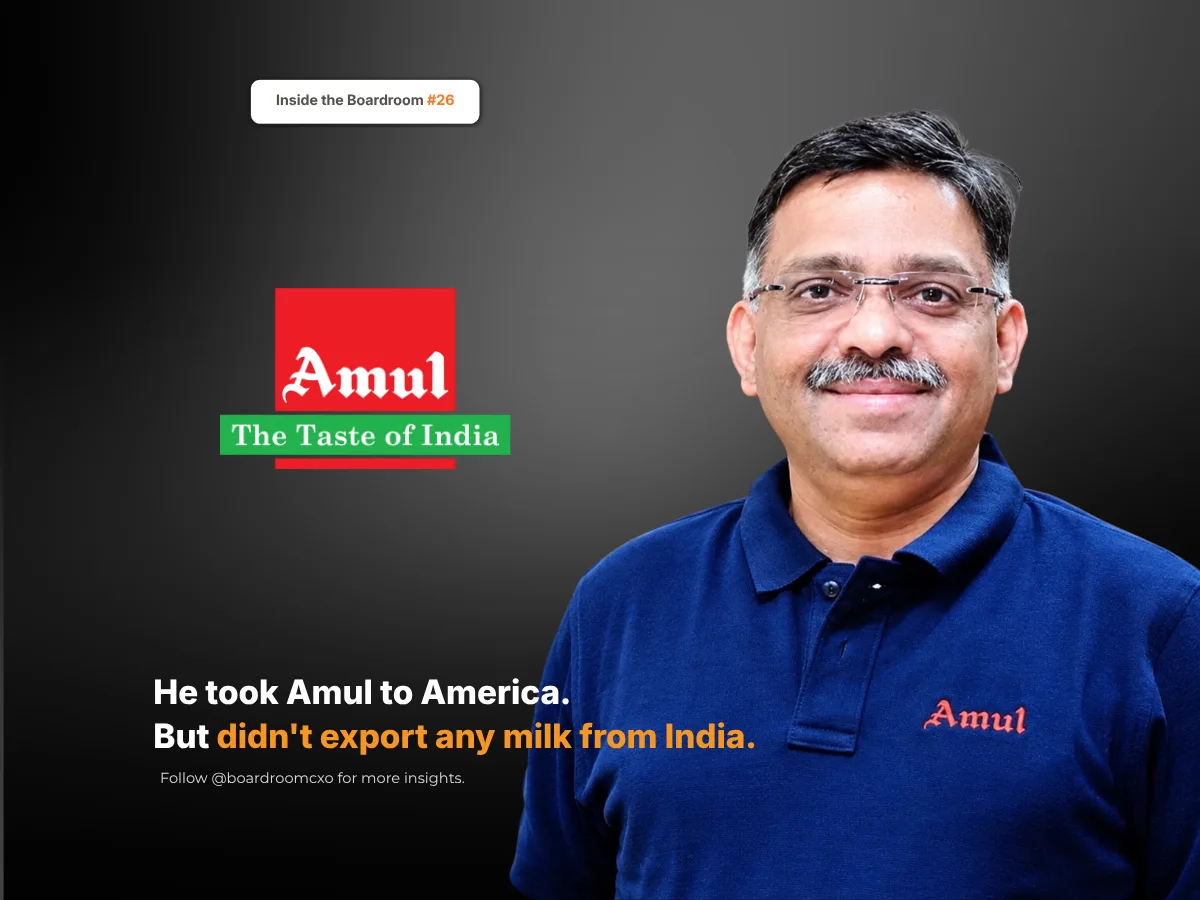
Jayen Mehta is the managing director of GCMMF. He joined Amul in 1991 from the Institute of Rural Management Anand (IRMA), worked through brand management and marketing roles, and rose to chief operating officer over about 32 years.
He took interim charge as managing director on 9 January 2023, when R S Sodhi stepped down, and was confirmed in the role in December 2024 for a five-year term.
"Buy a Cow, Become a Member of the Cooperative"
At the Business Today India@100 summit in August 2025, he was asked whether Amul would ever go public. He did not talk about valuation.
"Buy a cow, become a member of the cooperative," he said.
His point was that a listed company tries to buy cheap and sell high. Amul tries to pay farmers the most it can and give consumers the best value it can, which leaves little room for the kind of profit a stock market would value.
How Amul Went to America Without Exporting Milk
Most companies at that scale reach for capital markets to grow. Amul reached for American farmers.
On 20 March 2024, at the annual meeting of the Michigan Milk Producers Association (MMPA), a 108-year-old dairy cooperative, Mehta announced that Amul fresh milk would launch in the US. It came in four fat grades, Amul Gold, Shakti, Taaza and Slim, in gallon and half-gallon packs, for the East Coast and Midwest. It was the first time Amul fresh milk had launched outside India.
The part most people miss: none of the milk is shipped from India. MMPA collects and processes it from its own farmer members, and GCMMF brings the brand, the formulations and the marketing.
By October 2024, Amul Gold was on Costco shelves, starting on the East Coast, with a stated plan to reach all of Costco's roughly 750 US stores.
A cooperative from Anand now sells American milk to Americans, and still answers to farmers in Gujarat.
The Boardroom Lesson: Ownership Decides What a Business Is For
Most growth debates in a boardroom start with capital: how much to raise, at what valuation, from whom. Amul starts somewhere else. Its owners are its suppliers, so every decision is first a question about what it does for them.
Capital asks what a company is worth. Ownership decides what it is for.
That constraint did not stop Amul growing. It shaped how it grew: through the brand, the distribution and partnerships with other cooperatives, rather than through a share price.
Common Mistakes Boards Make When Growing an Unlisted Business
Boards of cooperatives, family businesses and other companies without a listing tend to make the same three errors as they scale.
They treat not listing as a weakness. A listing is one way to fund growth. Amul has reached ₹1 lakh crore without it. The question is whether the business can fund its plans, not whether it has a ticker.
They hire leaders who only know the listed playbook. A leader who measures success in valuation will struggle in a business whose owners want higher milk prices, not higher multiples.
They assume going abroad means exporting product. Amul took its brand to the US and left the milk local. Sometimes the asset that travels is the brand and the know-how.
A Framework for Hiring Leaders Into a Cooperative or Unlisted Business
When we brief boards on a CXO search for a cooperative, family-owned or unlisted company, we push for three specific checks.
- Ask candidates who the business is for. The right leader can say clearly who the owners are and what they want from the business, and will make decisions in that order.
- Look for builders, not financiers. Without a share price to lean on, growth comes from brand, distribution and operations. Hire leaders whose record is built on those.
- Value long tenure and inside knowledge. Mehta spent about 32 years inside Amul before running it. In a business with an unusual ownership model, understanding the system can matter more than outside experience.
Why This Belongs in the Boardroom, Not Just the Business Pages
This is the next chapter of the story we told of Verghese Kurien, who built the cooperative model that still decides how Amul grows. The leaders have changed. The owners have not.
Before a board decides how to grow, it has to know who the growth is for.
Sources
- Free Press Journal, Amul Crosses ₹1 Lakh Crore Turnover In FY26, Registers 11% Growth, April 2026
- Dairy Industries International, Amul brand turnover hits one trillion rupees and 11% growth, April 2026
- Business Standard, RS Sodhi steps down as Amul MD; Jayen Mehta given interim charge, January 2023
- Indian Cooperative, Mehta confirmed as MD of GCMMF for five years, December 2024
- Business Today, Jayen Mehta explains why Amul will never launch an IPO (BT India@100), August 2025
- Business Today, A first for India! Amul forays into US market with fresh milk range, March 2024
- DeshGujarat, Amul partners with Costco to launch fresh milk in U.S. retail market, October 2024
Related Reading
Verghese Kurien Packed His Bags to Leave Anand. He Stayed Fifty Years and Built Amul.
Read → R · 02 Founder Leadership · August 2026Ramesh Chauhan Sold Thums Up to Build Bisleri From Scratch
Read → R · 03 Founder Leadership · September 2026M P Ahammed: How a Coconut Trader Built India's Largest Jeweller
Read →Running a cooperative, family-owned or unlisted business that needs leaders who grow it without a share price?
We screen for leaders who understand who the business is for, not just how to raise its valuation. Brief us on your next CXO mandate and we will tell you what the market actually has to offer.
Brief Us on a Mandate See all Marketing & CMO roles we fill →