
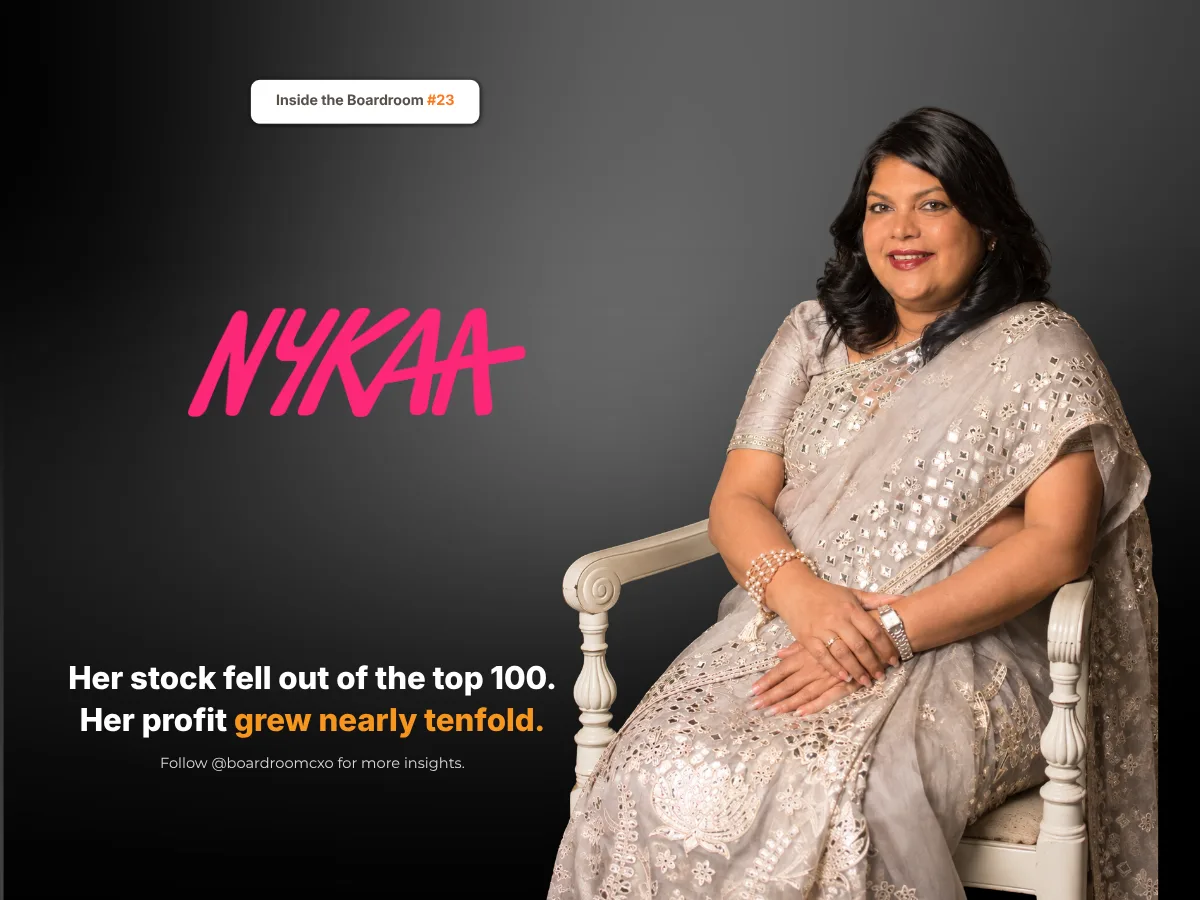
Key Takeaways
- Nykaa listed on 10 November 2021 at 79% above its issue price and crossed ₹1 lakh crore in market value on its first day.
- Within a year the stock fell 24% in a month and dropped out of India's 100 most valuable companies, but Falguni Nayar kept growing revenue by a quarter or more a year.
- Profit rose from ₹21 crore in FY23 to ₹204 crore in FY26 on revenue of ₹10,022 crore. Boards should judge a founder on the profit line, not the share price.
On 10 November 2021, Nykaa, the beauty and fashion e-commerce company founded by Falguni Nayar, listed on the NSE at 79% above its issue price and crossed ₹1 lakh crore in market value on its first day.
Not everyone bought the celebration.
Who Is Falguni Nayar?
Falguni Nayar is the founder, executive chairperson, managing director and chief executive of FSN E-Commerce Ventures, the company behind Nykaa. She spent about 25 years in finance and was managing director of Kotak Mahindra Capital when she left to start Nykaa in 2012, at 49, in a country where organised beauty retail barely existed.
"I was not afraid to be different," she told Fortune in early 2022.
Within months, the market gave her something new to be different about.
What Happened to the Stock
The euphoria did not last a year. In October 2022, ahead of the end of the one-year lock-in for pre-IPO investors, the stock fell 24% in a single month, dropped close to its ₹1,125 issue price and fell out of India's 100 most valuable companies. It was down more than half from its November 2021 high.
The commentary turned cruel: another glamour D2C listing that could not survive contact with the real market.
What She Did Instead of Explaining the Share Price
Most founders in that position start explaining the share price. She did not.
She kept doing what the business had been doing quietly since its IPO: growing revenue by a quarter or more every year, while the market told a different story. Revenue rose 36% in FY23, and kept growing in the mid-twenties after that.
Then the numbers closed the gap. Nykaa's net profit rose from ₹21 crore in FY23 to ₹72 crore in FY25 and ₹204 crore in FY26. Revenue crossed ₹10,000 crore for the first time, at ₹10,022 crore, making FY26 the company's first year above $1 billion in revenue. EBITDA grew 59% to ₹752 crore, and its fashion business turned EBITDA-positive.
In November 2025, with that turnaround on the books, Nykaa's board reappointed Falguni Nayar as executive chairperson, managing director and CEO for another five years, from February 2026.
The Boardroom Lesson: Sentiment and Business Are Two Different Verdicts
Most coverage of a falling stock treats the share price as the scorecard. It is one scorecard, and it moves on lock-in dates, sector moods and the last big listing that disappointed. The other scorecard is slower: revenue, margin and profit, quarter after quarter.
A falling stock is a verdict on sentiment. A rising profit line is a verdict on the business.
Nayar's answer to the first verdict was to keep working on the second. It took about three and a half years for the profit line to make the point for her.
Common Mistakes Boards Make When a Founder's Stock Falls After a Hot Listing
Boards of newly listed consumer and internet companies, and the investors watching them, tend to make the same three errors.
They treat the listing-day price as the baseline. A debut 79% above the issue price sets an expectation the business did not set. Judging the leader against that number punishes them for the market's excitement, not their own results.
They read lock-in selling as a verdict on the company. Nykaa's sharpest fall came as early investors were about to be free to sell. That says something about supply of shares. It says little about whether customers were still buying.
They push the founder to chase the share price. The easy response to a falling stock is a new story for investors. The harder one is to keep building the business the stock was supposed to be about.
A Framework for Evaluating a Founder-CEO After a Post-IPO Fall
When we brief boards on a CXO search for a newly listed consumer, beauty or D2C company, we push for three specific checks.
- Look at revenue growth through the bad stretch. If revenue kept growing by a quarter or more a year while the stock fell, the problem was the price, not the business.
- Track the profit line, not the headline. Nykaa's profit went from ₹21 crore to ₹204 crore over three years. Ask leadership candidates which line they would be judged on, and how long they would need.
- Check that the team can carry the next stage. Getting a business past ₹10,000 crore of revenue needs leaders across marketing, category, supply chain and finance who can keep growth and margin moving together.
Why This Belongs in the Boardroom, Not Just the Business Pages
This sits alongside the story we told of Varun Alagh at Honasa: another beauty company that listed to big expectations, lost the market's confidence, and won it back with results rather than statements.
The share price will always deliver its verdict first. Boards that hire well wait for the second one.
Sources
- Business Standard, Nykaa down 24% in one month, bows out of top-100 valued firms' club, October 2022
- Business Today, Nykaa shares hit fresh low, inch closer to IPO issue price, October 2022
- Fortune, 'I was not afraid to be different': How founding a company at 49 helped Nykaa CEO Falguni Nayar become a multi-billionaire, February 2022
- Daze Info, Nykaa's revenue in FY23 reached a new high of Rs 51.44 billion, profit declined 49% YoY, May 2023
- Angel One, Nykaa Q4 FY26 Results: Net Profit Jumps 183%, Crosses $1 Billion Revenue Milestone in FY26, May 2026
- YourStory, Nykaa crosses $1B annualised revenue mark as profitability surges, May 2026
- Nykaa (FSN E-Commerce Ventures), Re-appointment of Falguni Nayar as Executive Chairperson, Managing Director and CEO, November 2025
Related Reading
Varun Alagh: When Honasa Fell 40%, He Bought More
Read → R · 02 Founder Leadership · September 2026Venu Nair Took the Job Nobody Wanted at Shoppers Stop. He Turned It Around in About a Year.
Read → R · 03 Founder Leadership · September 2026Noel Tata: The Job He Didn't Get, and the One He Built Instead
Read →Building a beauty, retail or D2C business and need leaders who grow through a bad share price?
We screen for candidates who keep compounding the business when the market stops cheering, not just leaders who shine in a good year. Brief us on your next CXO mandate and we will tell you what the market actually has to offer.
Brief Us on a Mandate See all Marketing & CMO roles we fill →