
Key Takeaways
- Maruti Suzuki's share of India's passenger vehicle market fell to 39.26% in FY26, a 13-year low and the third straight year of decline, as utility vehicles grew to about two thirds of the market.
- In the same year it sold a record 24.22 lakh vehicles, earned record consolidated revenue of ₹1,83,382 crore, up 19.9%, and exported close to 4.5 lakh vehicles.
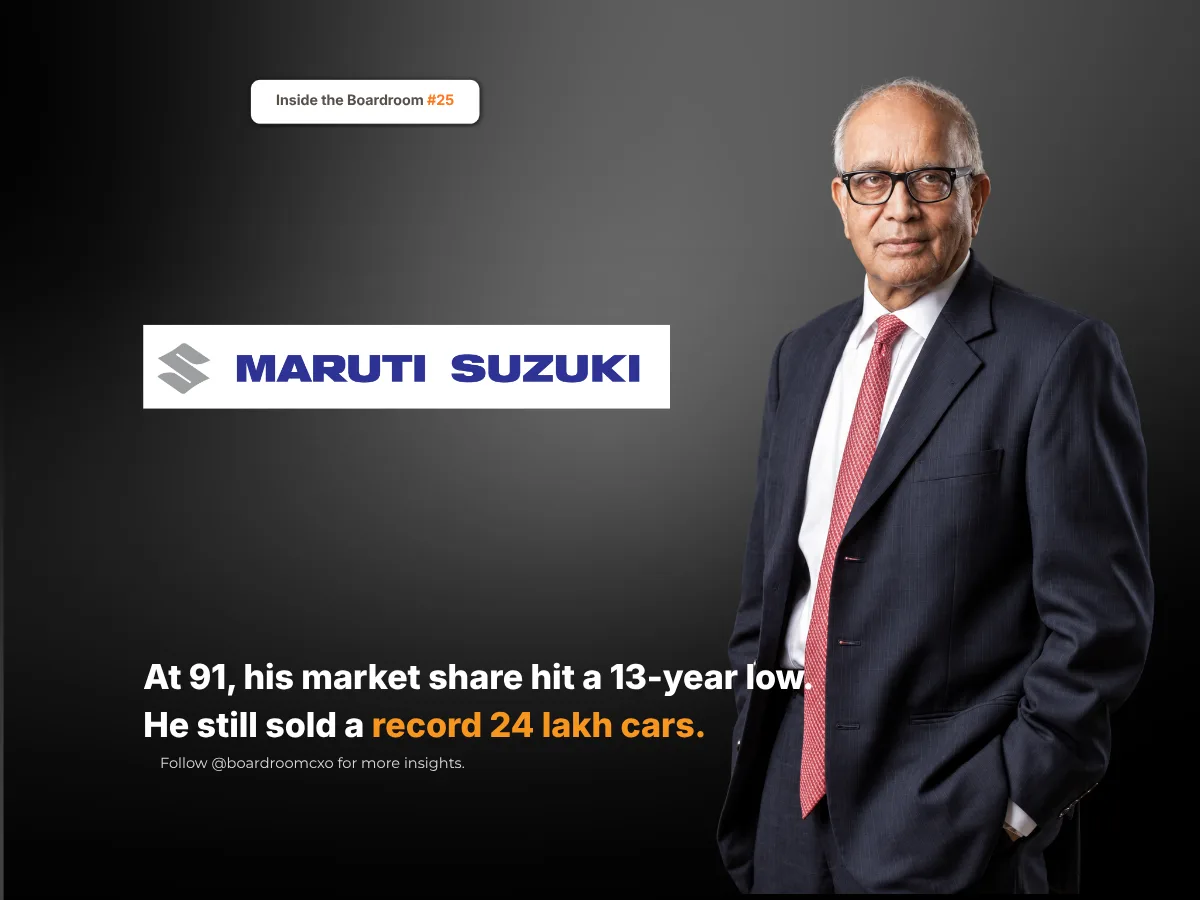
- Chairman R C Bhargava, 91, told analysts not to harp on market share and pointed to full capacity, volumes and profit. Boards should be clear which number they are actually running the company on.
Maruti Suzuki, India's largest carmaker, closed FY26 with its share of the passenger vehicle market at 39.26%, according to SIAM data. It was the lowest in thirteen years.
It was not a one-year story.
Why Maruti's Market Share Fell
FY26 was the third straight year the number had fallen. Maruti had held more than half the market as recently as FY19.
The reason sat inside the industry's own shift. Utility vehicles, SUVs and MPVs, grew to about 67% of India's passenger vehicle sales in FY26. Maruti Suzuki's share inside that segment was below 25%. Every rival gaining ground was gaining it there. Mahindra & Mahindra, for one, more than doubled its overall share in five years, to 14.21%, and became the country's second-largest carmaker.
Who Is R C Bhargava?
R C Bhargava is the chairman of Maruti Suzuki. A former IAS officer, he joined the company in 1981, when it was a government venture with Suzuki that had yet to build a car, and later served as its managing director. He has been chairman since 2007.
Forty-five years after he joined, at 91, he was still in the chairman's seat when the FY26 number came in.
What He Said Instead of Defending the Number
When the question came up after the FY26 results in April 2026, he did not defend the market share figure. He questioned why it mattered so much.
"So please don't harp on market share," he said.
His argument was that a car company should make sure the manufacturing capacity it has installed is fully used, and that it sells those cars at a reasonable profit. Gaining share, he said, would need capacity to be added at a much faster rate. Maruti was already building at two sites at once, at Kharkhoda in Haryana and a new site in Gujarat, and planned capital spending of about ₹14,000 crore for the year.
Most leaders watching share erode reach for a headline SUV launch or a price war. Bhargava pointed to a different set of numbers.
The Numbers Nobody Asked About
In the year its share hit that 13-year low, Maruti Suzuki sold 24.22 lakh vehicles, its highest ever, up from 22.34 lakh in FY25. Consolidated revenue from operations reached a record ₹1,83,382 crore, up 19.9%. It exported close to 4.5 lakh vehicles, more than any other carmaker in India.
Profit did not keep pace. Consolidated net profit rose only about 1%, to ₹14,680 crore, as costs climbed. The record was in volumes and revenue, not margins.
Its answer on electric cars followed the same logic. Maruti Suzuki's first EV, the e Vitara, was unveiled in January 2025 and launched in India in February 2026, priced from ₹10.99 lakh under a battery subscription plan. Exports began first. By June 2026, nearly 36,000 had been shipped overseas, about five times the roughly 7,000 dispatched to Indian dealers.
Bhargava has not called any of this a comeback.
The Boardroom Lesson: Market Share Is One Number, Not the Scorecard
Market share is the number analysts and the press quote back at a company. It is easy to read and easy to compare. But it is a ratio, and a ratio can fall while everything underneath it grows.
A shrinking share can still sit on top of a record year. The two numbers were never really arguing with each other.
The harder question for a board is not whether share is falling. It is whether the company is losing the customers it actually wants, at the margins it needs, in the segments that will matter in five years.
Common Mistakes Boards Make When Market Share Falls
Boards of market leaders in autos, consumer goods and other scale businesses tend to make the same three errors when share starts to slip.
They treat share as the only scorecard. A leader can lose share while selling more, earning more and exporting more. Judge the business on volume, revenue and profit alongside share, not instead of them.
They buy share back with price. A price war wins headlines and costs margin. Maruti's flat profit in a record revenue year shows how little room there is for that.
They ignore where the share is going. Maruti's share loss sat almost entirely in utility vehicles. A board that only watches the headline number misses which segment, and which customers, it is actually losing.
A Framework for Judging a Leader When Share Falls
When we brief boards on a CXO search for a market leader under pressure, we push for three specific checks.
- Split the share number by segment. Find out where the share is going. A fall concentrated in one fast-growing segment needs a product answer, not a sales push.
- Look at capacity, volume and profit together. If the plants are full and volumes are at a record, the constraint may be capacity, not demand. Ask leadership candidates which number they would manage to, and why.
- Hire for the segment you are losing. Winning back utility vehicle buyers takes product, marketing and sales leaders who have built in that segment, not just leaders from the segment the company already dominates.
Why This Belongs in the Boardroom, Not Just the Business Pages
This sits alongside the story we told of Gopal Vittal at Airtel, who let millions of low-paying customers go and was judged on revenue per user, not subscriber count. And it is the other side of the story we told of Anish Shah at Mahindra, one of the rivals that gained the share Maruti lost.
The share number will always be the first one quoted. Boards that hire well ask what sits underneath it.
Sources
- Outlook Business, Maruti Suzuki Loses Market Grip Amid SUV Shift, Share Slips to 13-year Low in FY26, April 2026
- Autocar Professional, SUV, MPV Sales Cross 3 Million for the First Time in FY2026, UV Share of PVs Jumps to 67%, April 2026
- Autocar Professional, "Don't Harp on Market Share": Maruti Suzuki's RC Bhargava Amid Aggressive Scale-up Plans, April 2026
- Autocar Professional, Maruti Suzuki Posts Record FY26 Revenue, but Profit Stays Flat As Costs Climb, April 2026
- Free Press Journal, Maruti Suzuki crosses 24,22,713 units in FY26 with record domestic and export volumes, April 2026
- electrive, India: Maruti Suzuki launches the e-Vitara as its first EV, February 2026
- Autocar Professional, Maruti e-Vitara Sales in India Cross 7,000 Units, Exports Exceed 35,000 Units, June 2026
Related Reading
Gopal Vittal: He Let 40 Million Customers Leave Airtel on Purpose
Read → R · 02 Founder Leadership · September 2026Anish Shah: The Outsider Who Fixed Mahindra's ₹5,200 Crore Problem
Read → R · 03 Founder Leadership · August 2026Everyone Said Royal Enfield Was Finished. Siddhartha Lal Asked for Two Years.
Read →Building a manufacturing, auto or consumer business where share and scale pull in different directions?
We screen for leaders who know which number actually runs the business, not just the one the market quotes back at them. Brief us on your next CXO mandate and we will tell you what the market actually has to offer.
Brief Us on a Mandate See all Sales & Retail roles we fill →