
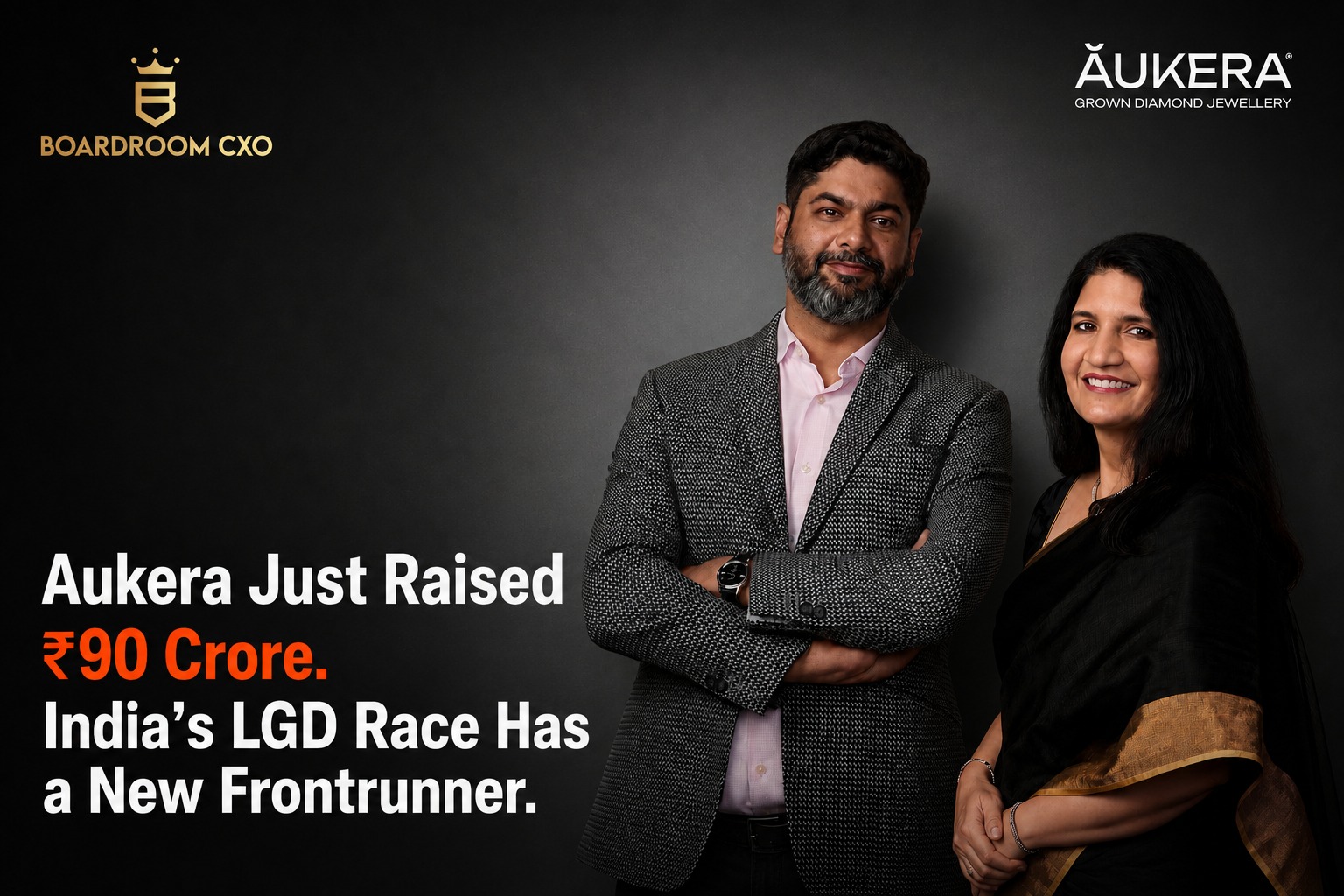
Aukera Grown Diamond Jewellery just raised ₹90 crore. Less than 12 months after raising ₹125 crore.
A lab-grown diamond jewellery brand founded in Bengaluru in 2023, in a category most Indian families are still figuring out. This is not just a funding story. It is a category-creation race in India's lab-grown diamond jewellery market, and the clock just started ticking louder.
What Is Aukera Grown Diamond Jewellery?
Aukera is a lab-grown diamond jewellery brand founded in 2023 by Lisa Mukhedkar and Kumar Saurabh. Lab-grown diamonds are chemically identical to mined diamonds: same hardness, same brilliance, same certifications. The only real difference is origin and price.
And yet, for most Indian families walking into a jewellery store today, the question is still the same. Is it real?
Why This Is a Trust Problem, Not a Product Problem
That question is not a consumer education problem. It is a trust infrastructure problem. Trust in jewellery is built through stores, buyback programmes, certified products, and a brand that feels permanent. Not through Instagram ads.
This is exactly what Mukhedkar and Saurabh are building at Aukera. Quietly, deliberately, and faster than most people in India's jewellery industry have noticed.
The Validation Moment Nobody Priced In
Recently, one of India's most trusted jewellery conglomerates entered and validated the lab-grown diamond category. When a legacy giant walks into a room, it does not just compete. It tells every Indian consumer that the category is real, permanent, and worth trusting.
That kind of validation is worth more than any marketing budget. It compresses years of category education into a single signal: if this established name is selling it, it must be legitimate.
What It Actually Costs to Lead This Category
Kumar Saurabh has said publicly that the category leader in India's lab-grown diamond space will need to invest at least ₹1,000 crore. Aukera has already gone from 13 to 35 company-owned stores in 12 months, backed by Peak XV Partners, Fireside Ventures, and Alteria Capital.
The window to define India's lab-grown diamond jewellery category is open. It will not stay open forever.
The Real Constraint Isn't Capital. It's the Bench.
Aukera has proven it can raise capital twice in a year. That was never going to be the hard part for a category this early and this large. The hard part is deploying ₹1,000 crore worth of ambition through a retail organization that has to move faster than a legacy player waking up to the same opportunity.
Going from 13 to 35 stores in a year is a store rollout problem, a certified-inventory problem, a buyback-programme design problem, and a category-education-at-the-counter problem, all at once. None of those get solved by the funding round. They get solved by the specific people running retail ops, merchandising, and BD, and by how fast a founder can hire them without diluting the trust the brand is trying to build.
Common Mistakes Founders Make in a Category-Creation Race
They mistake funding velocity for a moat. Two raises in 12 months signals investor confidence, not category ownership. A legacy player with an existing store network and consumer trust can close that gap faster than a funding round suggests.
They underinvest in trust infrastructure relative to growth infrastructure. It is easier to open a 36th store than to build a buyback programme customers actually believe in. In categories where the core objection is "is it real," trust infrastructure is the product, not a supporting function.
They hire generalist retail leaders instead of category-specific operators. Someone who has scaled a fashion D2C brand's retail footprint is not automatically equipped to run a jewellery store network where certification, buyback, and resale value are core to the customer promise. The skill sets look adjacent and are not identical.
They wait too long to build the leadership bench once a legacy player validates the category. Validation from an established name is a starting gun, not a reassurance. The founders who move fastest to staff up retail ops, BD, and category marketing in that window are the ones who convert validation into share.
A Framework for Founders Racing to Define a Category
- Treat every funding round as a hiring deadline, not just a growth budget. Capital deployed without the operators to execute it sits idle in a category where speed decides who owns the definition.
- Separate the growth story from the trust story, and staff both. Store count is a growth metric. Buyback redemption rates and certification consistency are trust metrics. They need different owners, not one generalist stretched across both.
- Hire ahead of the legacy player's response, not after it. Once a conglomerate validates a category, its own leadership bench mobilizes fast. The founders who already have their retail, BD, and ops leadership in place when that happens keep the lead. The ones still recruiting lose it.
Why This Belongs in the Boardroom
Category-creation races look like funding stories in the press and hiring stories on the ground. A ₹1,000 crore category-leader estimate is not a capital target so much as a signal of how large the operating organization behind it needs to be, across retail, merchandising, BD, and trust infrastructure. Boards backing a category creator should be asking the same question we ask on every jewellery and D2C mandate: is the leadership bench being built at the same speed as the funding round, or is it a step behind.
Frequently Asked Questions
What is Aukera Grown Diamond Jewellery?
Aukera Grown Diamond Jewellery is a lab-grown diamond jewellery brand founded in Bengaluru in 2023 by Lisa Mukhedkar and Kumar Saurabh. The company sells certified lab-grown diamond jewellery through a company-owned retail network that has expanded from 13 to 35 stores in 12 months.
How much funding has Aukera raised?
Aukera raised ₹90 crore in its most recent funding round, coming less than 12 months after an earlier ₹125 crore raise. Its backers include Peak XV Partners, Fireside Ventures, and Alteria Capital.
What is the difference between lab-grown and mined diamonds?
Lab-grown diamonds are chemically identical to mined diamonds, with the same hardness, brilliance, and certification standards. The primary differences are origin, since lab-grown diamonds are created in controlled environments rather than mined from the earth, and price, with lab-grown diamonds typically costing significantly less than mined equivalents of comparable quality.
Why does a legacy jewellery conglomerate entering the lab-grown diamond category matter?
When an established, trusted jewellery conglomerate enters a new category like lab-grown diamonds, it signals to consumers that the category is legitimate, permanent, and worth trusting, which is a harder outcome to achieve through advertising alone. In jewellery, where purchase trust depends on brand permanence and buyback assurance, this kind of validation from a legacy player can be more valuable than a marketing budget.
How much investment does it take to lead India's lab-grown diamond jewellery category?
Aukera co-founder Kumar Saurabh has stated publicly that the category leader in India's lab-grown diamond jewellery space will need to invest at least ₹1,000 crore, reflecting the scale of retail infrastructure, certification systems, and buyback programmes required to build consumer trust in a new jewellery category.
Related Reading
Solitario's Netflix Moment Exposes a Marketing Hiring Gap
Read → R · 02 Compensation Data · June 2026The Hidden Comp Gap: Why Jewelry Brands Keep Losing Candidates at the Offer Stage
Read → R · 03 Headhunting · June 2026Why the Best Performance Marketers in Jewelry Are Not on Naukri
Read →Racing to define a category before a legacy player catches up?
The capital rarely runs out first. The leadership bench does. We place the retail, BD, and category-marketing operators who can deploy a raise as fast as it lands.
Brief Us on a Mandate